History puzzle · July 31, 2026

Flames, famines, and fashionable flowers

From tulip bubbles to potato troubles!

Difficulty ★★★★ · 10 events

In Hand of History for July 31, 2026 you place these 10 real events back into the order they happened. Here they are in chronological order, with the date revealed and why each one matters.

Tulip mania peaks in the Dutch Republic — 1637
1637

Prices for tulip bulbs in the Dutch Republic reach extraordinary heights before the market collapses in a single February.

At the peak, a single bulb of the coveted 'Semper Augustus' variety costs roughly the price of a grand Amsterdam canal house.

Tulip mania was a period during the Dutch Golden Age when contract prices for some bulbs of the recently introduced and fashionable tulip reached extraordinarily high levels. The major acceleration started in 1634 and then dramatically collapsed in February 1637. It is generally considered to have been the first recorded speculative bubble or asset bubble in history. In many ways, the tulip mania was more of a then-unknown socio-economic phenomenon than a significant economic crisis. It had no critical influence on the prosperity of the Dutch Republic, which was one of the world's leading economic and financial powers in the 17th century, with the highest per capita income in the world from circa 1600 to 1720. The term tulip mania is now often used metaphorically to refer to any large economic bubble when asset prices deviate from intrinsic values.

📷 Wikimedia Commons

Great Fire destroys London — 1666
1666

A bakery fire on Pudding Lane tears through medieval London, destroying over 13,000 houses.

Despite the inferno incinerating a third of the city, official death records list only six fatalities — a number historians still puzzle over.

The Great Fire of London was a major conflagration that occurred in central London from Sunday 2 September to Wednesday 5 September 1666, gutting the medieval City of London inside the old Roman city wall, while also extending past the wall to the west. The death toll is generally thought to have been relatively small, although some historians have challenged this belief.

📷 Wikimedia Commons

1675

King Charles II issues a royal proclamation shutting down all coffee houses in England.

The ban collapses within eleven days after merchants and customers protest so loudly that the king quietly withdraws it.

Charles II's attempt to shut down coffee houses as hotbeds of sedition reveals how central these spaces had become to English political and intellectual life.

Louis XIV revokes Protestant freedoms — 1685
1685

Louis XIV signs the Edict of Fontainebleau, outlawing Protestant worship throughout France.

Around 200,000 Huguenot craftsmen and merchants flee to Britain, Prussia, and the Dutch Republic — inadvertently gifting France's rivals much of its skilled workforce.

The Edict of Fontainebleau, also known as the Revocation of the Edict of Nantes, was an edict issued by King Louis XIV of France, repealing the rights and freedoms afforded to the Huguenots and all non-catholic religions. The Edict of Nantes (1598) had granted Huguenots the right to practice their religion without state persecution. Protestants had lost their independence in places of refuge under Cardinal Richelieu on account of their supposed insubordination, but they continued to live in comparative security and political ease prior to the edict. From the outset, religious tolerance in France had been a royal, rather than popular, policy.

📷 Wikimedia Commons

1811

Fishwives from Musselburgh, Scotland, compete in the world's first recorded women's golf tournament.

The prizes are creels — the wicker baskets the women normally carry fish in — and a Barcelona silk handkerchief.

The first recorded women's golf competition, held at Musselburgh, Scotland, marks a landmark moment for women in sport centuries before female athletics gained broad recognition.

Potato blight devastates Ireland — 1845
1845

A water-mold pathogen called Phytophthora infestans destroys Ireland's potato harvest, the staple food of roughly half the population.

So many Irish emigrate to Boston and New York that within a decade Irish-born residents outnumber the native-born population in some city wards.

The Great Famine, also known as the Great Hunger, the Famine and the Irish Potato Famine, was a period of mass starvation and disease in Ireland from 1845 to 1852. It constituted a major historical social crisis and had a significant impact on Irish society and history. The most severely affected areas were in western and southern Ireland—where the Irish language was dominant—hence, in Irish, the period was contemporaneously known as an Drochshaol, which translates to "the bad life" and loosely translates to "the hard times". Debate exists regarding nomenclature for the event, including whether to use the terms "Famine", "Potato Famine" or "Great Hunger".

📷 Wikimedia Commons

Phylloxera wipes out French wine — 1863
1863

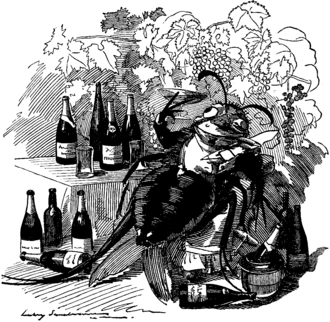
A microscopic louse called Phylloxera vastatrix begins quietly destroying the roots of French grapevines.

The eventual fix — grafting French vines onto resistant American rootstock — means virtually every bottle of French wine today grows on American roots.

The Great French Wine Blight was a severe blight of the mid-19th century that destroyed many of the vineyards in France and laid waste to the wine industry. It was caused by an insect that originated in North America and was carried across the Atlantic in the late 1850s. The actual genus of the insect is still debated, although it is largely considered to have been a species of Daktulosphaira vitifoliae, commonly known as grape phylloxera. While France is considered to have been worst affected, the blight also did a great deal of damage to vineyards in other European countries.

📷 Wikimedia Commons

1873

The Meiji government replaces Japan's centuries-old rice-based tax with a fixed cash payment tied to land value.

Because the tax is set at three percent of land value regardless of the harvest, a single bad crop can bankrupt a farming family — sparking dozens of peasant uprisings.

The Japanese Land Tax Reform of 1873, or chisokaisei (地租改正) was started by the Meiji Government in 1873, or the 6th year of the Meiji period. It was a major restructuring of the previous land taxation system, and established the right of private land ownership in Japan for the first time.

1877

Australia defeats England in the world's first official Test cricket match, played in Melbourne.

Australia wins by exactly 45 runs — and a century later, in 1977, the Centenary Test in the same city produces the identical margin of victory.

The inaugural Test match between Australia and England establishes cricket as the world's first truly international team sport with a standardized format.

Esperanto is born — 1887
1887

Warsaw oculist L. L. Zamenhof publishes a grammar for his invented language, Esperanto, under the pen name 'Doktoro Esperanto.'

The pseudonym means 'one who hopes' in the language itself — and it proves so catchy that speakers adopt it as the language's permanent name.

Dr. Esperanto's International Language, commonly referred to as Unua Libro, is an 1887 book by L. L. Zamenhof, in which he first introduced and described the constructed language Esperanto. First published in Russian on July 26 [O.S. July 14] 1887, the publication of Unua Libro marks the formal beginning of the Esperanto movement.

📷 Wikimedia Commons

Play today's puzzle ▸