History puzzle · July 13, 2026

Ancient wonders & empires

The deep past

Difficulty ☆☆☆☆ · 10 events

In Hand of History for July 13, 2026 you place these 10 real events back into the order they happened. Here they are in chronological order, with the date revealed and why each one matters.

Temple of Artemis rises at Ephesus — 550 BC
550 BC

Craftsmen complete the magnificent Temple of Artemis at Ephesus, one of the largest buildings in the ancient world.

The temple is so awe-inspiring that Alexander the Great later offers to fund its reconstruction after an arsonist burns it down — but the Ephesians politely refuse, saying it wouldn't be fitting for one god to build a temple to another.

The Temple of Artemis or Artemision, also known as the Temple of Diana, was a Greek temple dedicated to a localised form of the goddess Artemis. It was located in Ephesus, near modern day Selçuk in Turkey. While it had been destroyed and rebuilt many times in ancient history, the last incarnation of the temple was destroyed in 401 CE. Only foundations and fragments of the last temple remain in the present day.

📷 Wikimedia Commons

Cyrus issues his famous cylinder — 539 BC
539 BC

After taking Babylon without a battle, Cyrus the Great commissions a baked-clay cylinder to record his deeds.

The cylinder is written in Babylonian cuneiform — not Persian — so the conquered people can read their own 'liberation' in their own language.

The Cyrus Cylinder is an ancient clay cylinder, now broken into several pieces, on which is written an Achaemenid royal inscription in Akkadian cuneiform script in the name of the Persian king Cyrus the Great. It dates from the 6th century BC and was discovered in the ruins of the ancient Mesopotamian city of Babylon in 1879. It is currently in the possession of the British Museum. It was created and used as a foundation deposit following the Persian conquest of Babylon in 539 BC, when the Neo-Babylonian Empire was invaded by Cyrus and incorporated into his Persian Empire.

📷 Wikimedia Commons

Greeks defeat Persia at Marathon — 490 BC
490 BC

Outnumbered Athenian hoplites crush the Persian army on the plain of Marathon.

The messenger Pheidippides is said to have run to Sparta before the battle — 240 km in two days — to beg for help; Sparta declines, citing a religious festival.

The Battle of Marathon took place in 490 BC during the first Persian invasion of Greece. It was fought between the citizens of Athens, aided by Plataea, and a Persian force commanded by Datis and Artaphernes. The battle was the culmination of the first attempt by Persia under King Darius I to subjugate Greece. The Greek army inflicted a crushing defeat on the more numerous Persians, marking a turning point in the Greco-Persian Wars.

📷 Wikimedia Commons

Erechtheion dedicated on the Acropolis — 406 BC
406 BC

Athenians dedicate the Erechtheion, a marble temple crowning the Acropolis.

Six sculpted women, called caryatids, serve as the building's load-bearing columns — and one of them now stands in the British Museum in London.

The Erechtheion or Temple of Athena Polias is an ancient Greek Ionic temple, on the north side of the Acropolis, Athens, that was primarily dedicated to the goddess Athena.

📷 Wikimedia Commons

399 BC

An Athenian jury of 501 citizens votes to execute philosopher Socrates for impiety and corrupting the youth.

The vote is surprisingly close — 280 to 221 to convict — yet when Socrates proposes his own 'penalty' of free meals for life, the jury votes more heavily for death.

The Trial of Socrates was held to determine the philosopher's guilt of two charges against the city of Athens: asebeia (impiety) and corruption of the youth. The accusers cited two impious acts: "failing to acknowledge the gods of the city" and "introducing new deities".

331 BC

Alexander the Great personally paces out the boundaries of his new Egyptian city, Alexandria.

Running out of chalk to mark the grid lines, his surveyors use barley grain instead — an omen interpreted by the seers as a sign the city will abundantly feed the world.

Alexandria becomes the greatest city of the ancient Mediterranean world, home to its legendary library and lighthouse, and a crossroads of Greek, Egyptian, and later Roman civilisation.

Lighthouse of Alexandria completed — 280 BC
280 BC

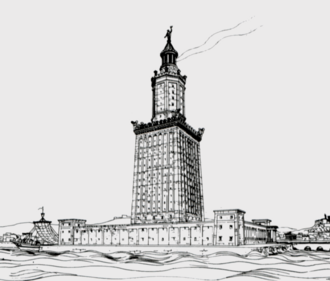
The Ptolemaic court completes the great Lighthouse of Alexandria on the island of Pharos.

The architect Sostratus of Cnidus reportedly carves his own name into the mortar beneath a plaster dedication to the ruling Ptolemies, betting the plaster will eventually flake away.

The Lighthouse of Alexandria, sometimes called the Pharos of Alexandria, was a lighthouse built by the Ptolemaic Kingdom of Ancient Egypt, during the reign of Ptolemy II Philadelphus. It has been estimated to have been at least 100 metres (330 ft) in overall height. One of the Seven Wonders of the Ancient World, for many centuries it was one of the world's tallest man-made structures.

📷 Wikimedia Commons

49 BC

Julius Caesar leads his Thirteenth Legion across the Rubicon river, an act of war against the Roman Senate.

The Rubicon was a tiny, unremarkable stream — its exact location is still debated by historians today, yet it gave the world the phrase 'crossing the Rubicon.'

The phrase "crossing the Rubicon" is an idiom meaning "passing the point of no return". Its meaning comes from the crossing of the Rubicon river by Julius Caesar in January 49 BC at the head of the 13th Legion. Caesar was not allowed to command an army within Italy proper, and by crossing the river with his forces was defying law and risking death. The crossing precipitated a civil war, which eventually led to Caesar becoming dictator for life.

Vesuvius buries Pompeii — 79
79

Mount Vesuvius erupts and buries the Roman city of Pompeii under several metres of volcanic ash and pumice.

Pliny the Younger, who watches from across the bay, writes two detailed letters to historian Tacitus — the earliest surviving eyewitness accounts of a volcanic eruption.

In 79 AD, Mount Vesuvius, a stratovolcano located in the modern-day region of Campania, Italy, erupted, causing one of the deadliest eruptions in history. Vesuvius violently ejected a cloud of super-heated tephra and gases to a height of 33 km (21 mi), ejecting molten rock, pulverized pumice and hot ash at 1.5 million tons per second, ultimately releasing 100,000 times the thermal energy of the atomic bombings of Hiroshima and Nagasaki. The event gives its name to the Vesuvian type of volcanic eruption, characterised by columns of hot gases and ash reaching the stratosphere, although the event also included pyroclastic flows associated with Peléan eruptions.

📷 Wikimedia Commons

Plague of Justinian strikes the empire — 541
541

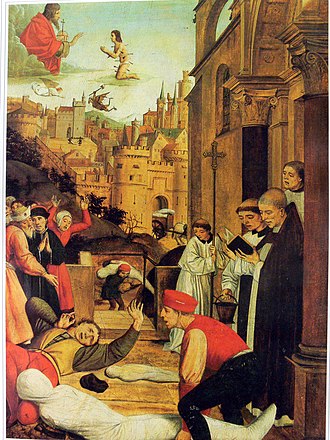
A devastating bubonic plague sweeps through Constantinople and the Byzantine Empire under Emperor Justinian I.

Justinian himself contracts the plague and survives — but the outbreak kills an estimated 5,000 people per day in Constantinople at its peak, forcing him to halt his reconquest of the West.

The plague of Justinian or Justinianic plague was an epidemic of plague that afflicted the entire Mediterranean Basin, Europe, and the Near East, especially the Sasanian Empire and the Byzantine Empire. The plague is named for the Byzantine Emperor Justinian I who, according to his court historian Procopius, contracted the disease and recovered in 542, at the height of the epidemic which killed about a fifth of the population in the imperial capital Constantinople. The contagion arrived in Roman Egypt in 541, spread around the Mediterranean Sea until 544, and persisted in Northern Europe and the Arabian Peninsula until 549. By 543, the plague had spread to every corner of Justinian's empire.

📷 Wikimedia Commons

Play today's puzzle ▸