History puzzle · July 12, 2026

Mixed eras

A little of everything

Difficulty ★★☆☆☆ · 10 events

In Hand of History for July 12, 2026 you place these 10 real events back into the order they happened. Here they are in chronological order, with the date revealed and why each one matters.

Battle of Marathon — 490 BC
490 BC

Outnumbered Athenians rout the Persian army on the plain of Marathon.

The Athenian general Miltiades orders his troops to sprint the final stretch — an unheard-of tactic designed to outrun the Persian archers' volley.

The Battle of Marathon took place in 490 BC during the first Persian invasion of Greece. It was fought between the citizens of Athens, aided by Plataea, and a Persian force commanded by Datis and Artaphernes. The battle was the culmination of the first attempt by Persia under King Darius I to subjugate Greece. The Greek army inflicted a crushing defeat on the more numerous Persians, marking a turning point in the Greco-Persian Wars.

📷 Wikimedia Commons

Spartans hold Thermopylae — 480 BC
480 BC

King Leonidas leads 300 Spartans — plus thousands of allied Greeks — to block the Persian army at the narrow pass of Thermopylae.

The Spartan force is betrayed when a local man named Ephialtes reveals a hidden mountain path, letting the Persians surround them from behind.

The Battle of Thermopylae was fought in 480 BC at Thermopylae between the Achaemenid Persian Empire under Xerxes and an alliance of Greek city-states led by Sparta under Leonidas I. Lasting over the course of three days, it was one of the most prominent battles of both the second Persian invasion of Greece and the wider Greco-Persian Wars.

📷 Wikimedia Commons

Battle of Hastings — 1066
1066

William of Normandy defeats King Harold II at Hastings, conquering England in a single afternoon.

Harold is traditionally said to have been killed by an arrow to the eye, though the Bayeux Tapestry — the main source — is ambiguous about which figure is actually Harold.

The Battle of Hastings was fought on 14 October 1066 between the Norman-French army of William, Duke of Normandy, and an English army under the Anglo-Saxon King Harold Godwinson, beginning the Norman Conquest of England. It took place approximately 7 mi (11 km) northwest of Hastings, close to the present-day town of Battle, East Sussex, and was a decisive Norman victory.

📷 Wikimedia Commons

Ottomans take Constantinople — 1453
1453

Ottoman Sultan Mehmed II captures Constantinople after a 53-day siege, ending the Byzantine Empire.

Mehmed has his massive cannon 'Basilica' — so large it takes 60 oxen to haul — fire stone balls weighing half a ton at the city's legendary walls.

The Fall of Constantinople, also known as the Conquest of Constantinople, was the capture of Constantinople, the capital city of the Byzantine Empire, by the Ottoman Empire. The city was captured on 29 May 1453 as part of the culmination of a 53-day siege which had begun on 6 April.

📷 Wikimedia Commons

Gutenberg prints the Bible — 1455
1455

Johannes Gutenberg completes his first printed Bible in Mainz, Germany.

He keeps the process so secret that his financier, Johann Fust, sues him for the loan and walks away with the press and the business.

The Gutenberg Bible, also known as the 42-line Bible, the Mazarin Bible or the B42, is the earliest major book printed in Europe using mass-produced metal movable type. It marked the start of the "Gutenberg Revolution" and the age of printed books in the West. The book is valued and revered for its high aesthetic and artistic qualities and its historical significance.

📷 Wikimedia Commons

Spanish Armada defeated — 1588
1588

England's smaller fleet, aided by fireships and a ferocious storm, destroys the supposedly invincible Spanish Armada.

Philip II of Spain, furious, reportedly tells his admiral: 'I sent you to fight against men, not against the wind and the waves.'

The Spanish Armada was a Spanish fleet that sailed from Lisbon in late May 1588, and was the largest engagement of the undeclared Anglo-Spanish War. The Armada was commanded by Alonso de Guzmán, Duke of Medina Sidonia, an aristocrat appointed by Philip II of Spain. His orders were to sail up the English Channel, join with the army of Alexander Farnese, Duke of Parma in Flanders, and escort an invasion force that would land in England and overthrow Elizabeth I. Its purpose was to reinstate Catholicism in England, end English support for the Dutch Republic in the north and prevent attacks by English and Dutch privateers against Spanish interests in the Americas.

📷 Wikimedia Commons

Boston Tea Party — 1773
1773

Colonial activists dump 342 chests of East India Company tea into Boston Harbor.

The protesters sweep the ships' decks clean afterward and replace a broken padlock — they want to make a political point, not commit theft.

The Boston Tea Party was an act of protest on December 16, 1773 during the American Revolution. Initiated by the Sons of Liberty in Boston, the capital of Massachusetts, one of the Thirteen Colonies of British America, it escalated hostilities between Great Britain and the Patriots, who opposed British policy towards its American colonies. Less than two years later, on April 19, 1775, the Battles of Lexington and Concord, also in Massachusetts, launched the eight-year American Revolutionary War, which resulted in the independence of the colonies as the United States.

📷 Wikimedia Commons

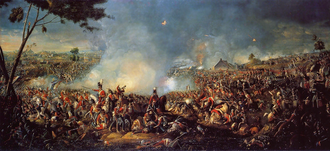
Napoleon defeated at Waterloo — 1815
1815

Wellington's coalition forces defeat Napoleon at Waterloo in a battle that lasts just one day.

Napoleon delays his attack until mid-morning to let the muddy ground dry — a choice historians argue cost him the battle.

The Battle of Waterloo was fought on Sunday 18 June 1815, near Waterloo, being the last engagement with Napoleon I. The French Imperial Army under the command of Napoleon I was defeated by two armies of the Seventh Coalition. One was a British-led force with units from the United Kingdom, the Netherlands, Hanover, Brunswick, and Nassau, under the command of field marshal Arthur Wellesley, Duke of Wellington. The other comprised three corps of the Prussian army under Field Marshal Blücher. The battle was known contemporaneously as the Battle of Mont Saint-Jean in France and La Belle Alliance in Prussia.

📷 Wikimedia Commons

Brooklyn Bridge opens — 1883
1883

The Brooklyn Bridge opens after 14 years of construction, crossing New York's East River.

A week after opening, a rumor that the bridge is about to collapse triggers a stampede — twelve people are crushed to death on the bridge itself.

The Brooklyn Bridge is a cable-stayed suspension bridge in New York City, spanning the East River between the boroughs of Manhattan and Brooklyn. Opened on May 24, 1883, the Brooklyn Bridge was the first fixed crossing of the East River. It was also the longest suspension bridge in the world when opened, with a main span of 1,595.5 feet (486.3 m) and a deck 127 ft (38.7 m) above mean high water. The span was originally called the New York and Brooklyn Bridge or the East River Bridge but was officially renamed the Brooklyn Bridge in 1915.

📷 Wikimedia Commons

Berlin Wall falls — 1989
1989

East German authorities unexpectedly open the Berlin Wall, and crowds begin tearing it down with hammers.

The announcement is made live on TV by a flustered spokesman who had not yet read the memo — he mistakenly says the border crossings open 'immediately, without delay.'

The Berlin Wall fell on 9 November 1989 during the Peaceful Revolution, marking the beginning of the destruction of the figurative Iron Curtain, as East Berlin transit restrictions were overwhelmed and discarded. Sections of the wall were breached, and planned deconstruction began the following June. It was one of the series of events that started the fall of communism in Central and Eastern Europe. The fall of the inner German border took place shortly afterward. An end to the Cold War was declared at the Malta Summit in early December, and German reunification took place in October the following year.

📷 Wikimedia Commons

Play today's puzzle ▸