History puzzle · July 10, 2026

The industrial & modern age

Steam to silicon

Difficulty ★★★★ · 10 events

In Hand of History for July 10, 2026 you place these 10 real events back into the order they happened. Here they are in chronological order, with the date revealed and why each one matters.

Great Exhibition opens in London — 1851
1851

Queen Victoria opens the Great Exhibition inside a colossal iron-and-glass palace in Hyde Park.

The building itself is so enormous that fully grown elm trees are enclosed inside it — sparrows and all.

The Great Exhibition of the Works of Industry of All Nations, also known as the Great Exhibition or the Crystal Palace Exhibition, was an international exhibition that took place in Hyde Park, London, from 1 May to 15 October 1851. It was the first in a series of world's fairs, exhibitions of culture and industry that became popular in the 19th century. The event was organised by Henry Cole and Albert, Prince Consort of Victoria, Queen of the United Kingdom.

📷 Wikimedia Commons

First transatlantic telegraph cable laid — 1866
1866

The SS Great Eastern lays the first permanent telegraph cable across the floor of the Atlantic Ocean.

An earlier 1858 cable lasted only three weeks before the operator burned it out by blasting it with 2,000 volts trying to boost the signal.

Transatlantic telegraph cables are undersea cables running under the Atlantic Ocean which were used for telegraph communications.

📷 Wikimedia Commons

Brooklyn Bridge opens — 1883
1883

The Brooklyn Bridge opens to the public after 14 years of construction.

A week after opening, a rumour that it is about to collapse causes a stampede — 12 people are trampled to death.

The Brooklyn Bridge is a cable-stayed suspension bridge in New York City, spanning the East River between the boroughs of Manhattan and Brooklyn. Opened on May 24, 1883, the Brooklyn Bridge was the first fixed crossing of the East River. It was also the longest suspension bridge in the world when opened, with a main span of 1,595.5 feet (486.3 m) and a deck 127 ft (38.7 m) above mean high water. The span was originally called the New York and Brooklyn Bridge or the East River Bridge but was officially renamed the Brooklyn Bridge in 1915.

📷 Wikimedia Commons

First modern Olympic Games held — 1896
1896

The first modern Olympic Games open in Athens, Greece, with athletes from 14 nations competing.

The marathon distance is specifically set to match the legendary run from Marathon to Athens — and the race is won by a Greek water-carrier named Spyridon Louis.

The 1896 Summer Olympics, officially known as the Games of the I Olympiad, and commonly known as Athens 1896, were the first international Olympic Games held in modern history. Organised by the International Olympic Committee (IOC), which had been created by French aristocrat Pierre de Coubertin, the event was held in Athens, Greece, from 6 to 15 April 1896.

📷 Wikimedia Commons

1913

Henry Ford installs a moving assembly line at his Highland Park plant, revolutionising car production.

The line moves so fast that workers are forbidden to sit or talk, and turnover in the first year tops 370% — Ford responds by doubling wages to $5 a day.

Ford's moving assembly line at Highland Park slashes the time to build a car from over 12 hours to 93 minutes, transforming manufacturing worldwide.

1926

Robert Goddard launches the world's first liquid-fueled rocket from a farm in Auburn, Massachusetts.

The entire flight lasts just 2.5 seconds, reaching a height of about 12 metres — roughly the height of a two-storey house.

Robert Goddard's successful liquid-fueled rocket launch proves the concept that will eventually carry humans to the Moon.

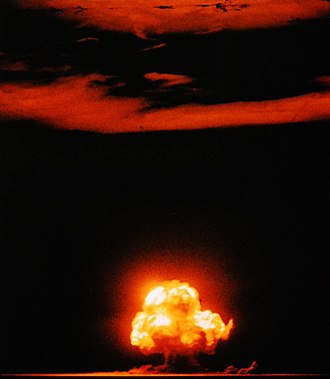
Trinity nuclear test detonated — 1945
1945

The world's first atomic bomb is detonated at the Trinity test site in New Mexico.

The heat fuses the desert sand into a new greenish glass-like mineral that scientists later name 'trinitite.'

Trinity was the first detonation of a nuclear weapon, conducted by the United States Army at 5:29 a.m. Mountain War Time on July 16, 1945, as part of the Manhattan Project. The test was of an implosion-design plutonium bomb, or "gadget" – the same design as the Fat Man bomb later detonated over Nagasaki, Japan, on August 9, 1945. Concerns about whether the complex Fat Man design would work led to a decision to conduct the first nuclear test. The code name "Trinity" was assigned by J. Robert Oppenheimer, the director of the Los Alamos Laboratory. The name was possibly inspired by the poetry of John Donne.

📷 Wikimedia Commons

First stored-program computer runs — 1948
1948

The Manchester Small-Scale Experimental Machine — nicknamed 'Baby' — runs the world's first stored program in memory.

The program's entire purpose is to find the highest factor of a number, a task that takes 52 minutes and involves the machine checking 3.5 million operations.

The Manchester Baby, also called the Small-Scale Experimental Machine (SSEM), was the first electronic stored-program computer. It was built at the Victoria University of Manchester by Frederic C. Williams, Tom Kilburn, and Geoff Tootill, and ran its first program on 21 June 1948.

📷 Wikimedia Commons

First nuclear electricity goes on the grid — 1956
1956

Queen Elizabeth II opens Calder Hall, the world's first full-scale nuclear power station, in Cumberland, England.

The plant's official purpose is generating civilian electricity, but its reactors are also quietly producing plutonium for Britain's nuclear weapons programme.

Calder Hall Nuclear Power Station is a former Magnox nuclear power station on the Sellafield site in Cumbria in North West England. Calder Hall was the first full-scale nuclear power station to enter operation in the West, and was the sister plant to the Chapelcross plant in Scotland. Both were commissioned and originally operated by the United Kingdom Atomic Energy Authority. The primary purpose of both plants was to produce weapons-grade plutonium for the UK's nuclear weapons programme, but they also generated electrical power for the National Grid.

📷 Wikimedia Commons

World Wide Web goes public — 1991
1991

Tim Berners-Lee makes the World Wide Web publicly available to anyone with a computer and an internet connection.

Berners-Lee's boss at CERN had originally returned his proposal with the note 'vague but exciting' written in pencil — and almost nothing came of it.

The World Wide Web is a global interconnected information system that enables content sharing over the Internet. It facilitates access to documents and other web resources according to specific rules of the Hypertext Transfer Protocol (HTTP).

📷 Wikimedia Commons

Play today's puzzle ▸