History puzzle · July 6, 2026

Ancient wonders & empires

The deep past

Difficulty ☆☆☆☆ · 10 events

In Hand of History for July 6, 2026 you place these 10 real events back into the order they happened. Here they are in chronological order, with the date revealed and why each one matters.

539 BC

Cyrus the Great marches into Babylon without a battle, taking the city in a single night.

He immediately frees the peoples enslaved there by Babylon — including the Jews — and lets them return home with their sacred objects.

Cyrus's bloodless conquest of Babylon creates the largest empire the world has yet seen and sets a template for multicultural rule.

399 BC

An Athenian jury of 500 citizens votes to execute the philosopher Socrates for impiety and corrupting the youth.

The vote is surprisingly close — 280 to 220 to convict — but Socrates then antagonises the jury by suggesting his 'punishment' should be free meals for life.

The Trial of Socrates was held to determine the philosopher's guilt of two charges against the city of Athens: asebeia (impiety) and corruption of the youth. The accusers cited two impious acts: "failing to acknowledge the gods of the city" and "introducing new deities".

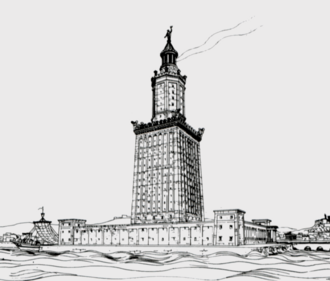
Lighthouse of Alexandria completed — 280 BC
280 BC

The great Lighthouse of Alexandria rises on the island of Pharos off Egypt's coast, standing over 100 metres tall.

The architect Sostratus of Cnidus reportedly carves his own name into the stone under a plaster dedication to the king, so posterity would remember him once the plaster crumbled.

The Lighthouse of Alexandria, sometimes called the Pharos of Alexandria, was a lighthouse built by the Ptolemaic Kingdom of Ancient Egypt, during the reign of Ptolemy II Philadelphus. It has been estimated to have been at least 100 metres (330 ft) in overall height. One of the Seven Wonders of the Ancient World, for many centuries it was one of the world's tallest man-made structures.

📷 Wikimedia Commons

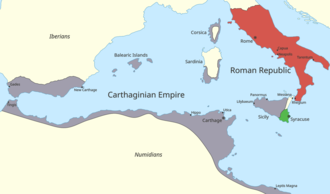
Rome and Carthage fight the First Punic War — 264 BC
264 BC

Rome and Carthage go to war over the island of Sicily in the first of three massive conflicts between the two powers.

Rome has almost no warships at the start, so it reverse-engineers a wrecked Carthaginian galley and trains its crews to row on benches set up on dry land.

The First Punic War was the first of three wars fought between Rome and Carthage, the two main powers of the western Mediterranean in the early 3rd century BC. For 23 years, in the longest continuous conflict and greatest naval war of antiquity, the two powers struggled for supremacy. The war was fought primarily on the Mediterranean island of Sicily and its surrounding waters, and also in North Africa. After immense losses on both sides, the Carthaginians were defeated and Rome gained territory from Carthage.

📷 Wikimedia Commons

218 BC

The Carthaginian general Hannibal leads his army — and 37 war elephants — over the Alps into Italy.

The crossing takes about 15 days in autumn snow; by the time Hannibal reaches the Po valley, he has lost roughly half his men and almost all of the elephants.

Hannibal's audacious crossing of the Alps with war elephants stuns Rome and nearly breaks the Republic during the Second Punic War.

146 BC

Roman forces raze Carthage to the ground after a brutal three-year siege, selling its surviving population into slavery.

The Roman senator Cato the Elder had ended virtually every speech for years — regardless of the topic — with 'Carthago delenda est': Carthage must be destroyed.

Rome's total obliteration of Carthage ends a century of rivalry and cements Roman dominance over the entire Mediterranean world.

49 BC

Julius Caesar leads his army across the Rubicon river into Italy, an act that is legally an act of war against the Roman Senate.

The Rubicon itself is so small and unremarkable that historians debated for centuries which river it actually was — it was only officially identified in 1933.

The phrase "crossing the Rubicon" is an idiom meaning "passing the point of no return". Its meaning comes from the crossing of the Rubicon river by Julius Caesar in January 49 BC at the head of the 13th Legion. Caesar was not allowed to command an army within Italy proper, and by crossing the river with his forces was defying law and risking death. The crossing precipitated a civil war, which eventually led to Caesar becoming dictator for life.

Edict of Milan issued — 313
313

Emperors Constantine and Licinius issue the Edict of Milan, granting all people in the Roman Empire freedom of worship.

Technically the document issued at Milan is a letter to provincial governors, not a formal edict — historians still argue about what to call it.

The Edict of Milan was the 13 February 313 AD agreement to treat Christians benevolently within the Roman Empire. Western Roman Emperor Constantine I and Emperor Licinius, who controlled the Balkans, met in Mediolanum and, among other things, agreed to change policies towards Christians following the edict of toleration issued by Emperor Galerius two years earlier in Serdica. The Edict of Milan gave Christianity legal status and a reprieve from persecution but did not make it the state church of the Roman Empire, which occurred in AD 380 with the Edict of Thessalonica, when Nicene Christianity received normative status.

📷 Wikimedia Commons

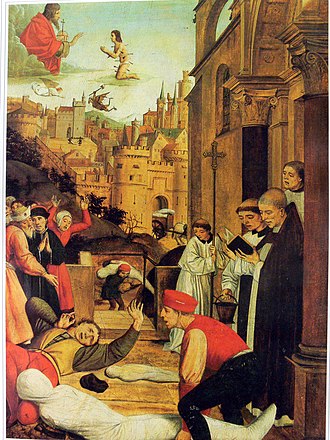
Plague of Justinian strikes the empire — 541
541

A devastating plague sweeps through the Byzantine Empire, killing thousands per day in Constantinople alone.

Emperor Justinian himself contracts the illness but survives — contemporary historian Procopius, who loathed the emperor, seemed almost disappointed to record his recovery.

The plague of Justinian or Justinianic plague was an epidemic of plague that afflicted the entire Mediterranean Basin, Europe, and the Near East, especially the Sasanian Empire and the Byzantine Empire. The plague is named for the Byzantine Emperor Justinian I who, according to his court historian Procopius, contracted the disease and recovered in 542, at the height of the epidemic which killed about a fifth of the population in the imperial capital Constantinople. The contagion arrived in Roman Egypt in 541, spread around the Mediterranean Sea until 544, and persisted in Northern Europe and the Arabian Peninsula until 549. By 543, the plague had spread to every corner of Justinian's empire.

📷 Wikimedia Commons
Charlemagne crowned Holy Roman Emperor — 800
800

Pope Leo III crowns Charlemagne Emperor of the Romans in St. Peter's Basilica on Christmas Day.

Charlemagne later claims he was taken completely by surprise by the coronation and would never have entered the church had he known what the Pope was planning — though historians remain sceptical.

Charlemagne was King of the Franks from 768, King of the Lombards from 774, and Emperor of what is now known as the Carolingian Empire from 800. He united most of Western and Central Europe and was the first recognised emperor to rule from the west after the fall of the Western Roman Empire approximately three centuries earlier. Charlemagne's reign was marked by political and social changes that had lasting influence on Europe throughout the Middle Ages.

📷 Wikimedia Commons

Play today's puzzle ▸