History puzzle · July 5, 2026

Mixed eras

A little of everything

Difficulty ★★☆☆☆ · 10 events

In Hand of History for July 5, 2026 you place these 10 real events back into the order they happened. Here they are in chronological order, with the date revealed and why each one matters.

First Olympic Games held — 776 BC
776 BC

Greek city-states gather at Olympia to compete in the first recorded Olympic Games.

The entire programme consists of a single event: a foot race roughly 192 metres long, called the stadion.

The ancient Olympic Games, or the ancient Olympics, were a series of athletic competitions among representatives of city-states and one of the Panhellenic Games of ancient Greece. They were held at the Panhellenic religious sanctuary of Olympia, in honor of Zeus, and the Greeks gave them a mythological origin. The originating Olympic Games are traditionally dated to 776 BC. The games were held every four years, or Olympiad, which became a unit of time in historical chronologies. These Olympiads were referred to based on the winner of their stadion sprint, e.g., "the third year of the eighteenth Olympiad when Ladas of Argos won the stadion". They continued to be celebrated when Greece came under Roman rule in the 2nd century BC. Their last recorded celebration was in AD 393, under the emperor Theodosius I, but archaeological evidence indicates that some games were still held after this date. The games likely came to an end under Theodosius II, possibly in connection with a fire that burned down the temple of the Olympian Zeus during his reign.

📷 Wikimedia Commons
218 BC

Carthaginian general Hannibal leads his army — elephants included — over the Alps into Italy.

Of the roughly 37 elephants that begin the crossing, only one survives the Italian campaign long enough to be used in battle.

Hannibal's audacious alpine crossing brings a Carthaginian army with war elephants onto Italian soil, shocking Rome to its core.

Plague of Justinian strikes the empire — 541
541

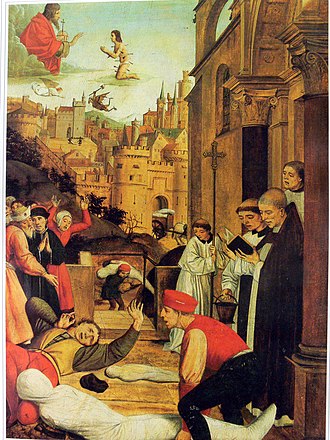
A devastating plague erupts across the Byzantine Empire, striking Constantinople with lethal force.

Emperor Justinian himself contracts the disease but recovers — leaving him too ill to oversee his armies during a critical military campaign.

The plague of Justinian or Justinianic plague was an epidemic of plague that afflicted the entire Mediterranean Basin, Europe, and the Near East, especially the Sasanian Empire and the Byzantine Empire. The plague is named for the Byzantine Emperor Justinian I who, according to his court historian Procopius, contracted the disease and recovered in 542, at the height of the epidemic which killed about a fifth of the population in the imperial capital Constantinople. The contagion arrived in Roman Egypt in 541, spread around the Mediterranean Sea until 544, and persisted in Northern Europe and the Arabian Peninsula until 549. By 543, the plague had spread to every corner of Justinian's empire.

📷 Wikimedia Commons

Battle of Hastings — 1066
1066

Norman duke William defeats King Harold II of England at the Battle of Hastings.

Harold is killed — and the Bayeux Tapestry shows an arrow piercing a figure's eye, though historians still debate whether it truly depicts Harold's death.

The Battle of Hastings was fought on 14 October 1066 between the Norman-French army of William, Duke of Normandy, and an English army under the Anglo-Saxon King Harold Godwinson, beginning the Norman Conquest of England. It took place approximately 7 mi (11 km) northwest of Hastings, close to the present-day town of Battle, East Sussex, and was a decisive Norman victory.

📷 Wikimedia Commons

Norman conquest of England — 1066
1066

Duke William of Normandy defeats King Harold II at the Battle of Hastings.

Harold is reported in the Bayeux Tapestry as being struck in the eye by an arrow — though some historians think he is shown cut down by a sword in the same scene.

The Battle of Hastings was fought on 14 October 1066 between the Norman-French army of William, Duke of Normandy, and an English army under the Anglo-Saxon King Harold Godwinson, beginning the Norman Conquest of England. It took place approximately 7 mi (11 km) northwest of Hastings, close to the present-day town of Battle, East Sussex, and was a decisive Norman victory.

📷 Wikimedia Commons

Gutenberg prints the Bible — 1455
1455

Johannes Gutenberg rolls the first printed copies of the Bible off his press in Mainz.

Each copy still has to be hand-rubricated and illuminated by a scribe afterward, so buyers can't easily tell it from a manuscript.

The Gutenberg Bible, also known as the 42-line Bible, the Mazarin Bible or the B42, is the earliest major book printed in Europe using mass-produced metal movable type. It marked the start of the "Gutenberg Revolution" and the age of printed books in the West. The book is valued and revered for its high aesthetic and artistic qualities and its historical significance.

📷 Wikimedia Commons

Newton publishes the Principia — 1687
1687

Isaac Newton publishes his Principia Mathematica, setting out the laws of motion and gravity.

The entire print run of about 300 copies is funded by astronomer Edmond Halley, because the Royal Society had already spent its budget on a book about fish.

Philosophiæ Naturalis Principia Mathematica, often called simply the Principia, is a book by Sir Isaac Newton that expounds Newton's laws of motion and his law of universal gravitation.

📷 Wikimedia Commons

Storming of the Bastille — 1789
1789

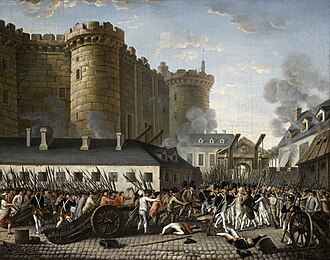
Parisian crowds storm the Bastille fortress, freeing its prisoners and seizing its gunpowder.

The fearsome symbol of royal oppression holds only seven prisoners at the time — including two who are simply mentally ill.

The Storming of the Bastille, which occurred in Paris, France, on 14 July 1789, was an act of political violence by revolutionary insurgents who attempted to storm and seize control of the medieval armoury, fortress, and political prison known as the Bastille. After four hours of fighting and 94 deaths, the insurgents were able to enter the Bastille. The governor of the Bastille, Bernard-René Jourdan de Launay, and several members of the garrison were killed after surrendering. At the time, the Bastille represented royal authority in the centre of Paris. The prison contained only seven inmates at the time of its storming and was already scheduled for demolition but was seen by the revolutionaries as a symbol of the monarchy's abuse of power. Its fall was the flashpoint of the French Revolution.

📷 Wikimedia Commons

Napoleon defeated at Waterloo — 1815
1815

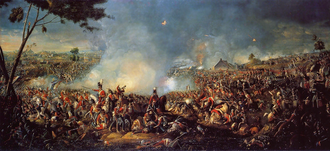
The Duke of Wellington and Prussian forces crush Napoleon Bonaparte at Waterloo in present-day Belgium.

Napoleon delays the battle's start until late morning, reportedly to let the waterlogged ground dry — giving the Prussians extra time to arrive.

The Battle of Waterloo was fought on Sunday 18 June 1815, near Waterloo, being the last engagement with Napoleon I. The French Imperial Army under the command of Napoleon I was defeated by two armies of the Seventh Coalition. One was a British-led force with units from the United Kingdom, the Netherlands, Hanover, Brunswick, and Nassau, under the command of field marshal Arthur Wellesley, Duke of Wellington. The other comprised three corps of the Prussian army under Field Marshal Blücher. The battle was known contemporaneously as the Battle of Mont Saint-Jean in France and La Belle Alliance in Prussia.

📷 Wikimedia Commons

1844

Samuel Morse sends the first long-distance telegraph message from Washington D.C. to Baltimore.

The message he chooses — 'What hath God wrought?' — is actually picked for him by the daughter of the Patent Commissioner.

Samuel Morse's first long-distance telegraph message proves that words can travel instantly across wires, shrinking the world overnight.

Play today's puzzle ▸