History puzzle · June 30, 2026

Voyages & exploration

Charting the unknown

Difficulty ★★☆☆☆ · 10 events

In Hand of History for June 30, 2026 you place these 10 real events back into the order they happened. Here they are in chronological order, with the date revealed and why each one matters.

Leif Erikson reaches Vinland — 1000
1000

Norse explorer Leif Erikson makes landfall in a lush new territory he calls Vinland.

The sagas say he finds grapes so plentiful that his crew loads the ship with them to bring back to Greenland.

Vinland, Vineland, or Winland was an area of coastal North America explored by Vikings. Leif Erikson landed there around AD 1000, nearly five centuries before the voyages of Christopher Columbus and John Cabot. The name appears in the Vinland sagas and describes a land beyond Greenland, Helluland, and Markland. Much of the geographical content of the sagas corresponds to present-day knowledge of transatlantic travel and North America.

📷 Wikimedia Commons

Marco Polo returns from the East — 1295
1295

Marco Polo arrives back in Venice after 24 years traveling through the courts of Kublai Khan.

His fellow Venetians are so skeptical of his stories that they nickname him 'Il Milione' — the man of a million tall tales.

Marco Polo was a Venetian merchant, explorer, and writer who travelled through Asia along the Silk Road between 1271 and 1295. His travels are recorded in The Travels of Marco Polo, a book that described the then-mysterious culture and inner workings of the Eastern world, including the wealth and great size of the Mongol Empire and China under the Yuan dynasty, giving Europeans their first comprehensive look into China, Persia, India, Japan, and other Asian societies.

📷 Wikimedia Commons

Dias rounds the Cape of Good Hope — 1488
1488

Portuguese navigator Bartolomeu Dias rounds the southern tip of Africa in stormy seas.

He originally names it the 'Cape of Storms,' but King João II overrules him and insists on the more optimistic 'Cape of Good Hope.'

Bartolomeu Dias was a Portuguese mariner and explorer. In February 1488, he became the first European navigator to round the southern tip of Africa and to demonstrate that the most effective southward route for ships is in the open ocean, well to the west of the African coast. His discoveries were later used by Vasco da Gama to establish a sea route between Europe and Asia.

📷 Wikimedia Commons

Cabot claims North America for England — 1497
1497

Italian-born explorer John Cabot, sailing under the English flag, makes landfall on the coast of North America.

Henry VII rewards him for 'finding' the new isle with a modest one-time payment of just ten pounds.

John Cabot was an Italian navigator and explorer. His 1497 voyage to the coast of North America under the commission of Henry VII, King of England is the earliest known European exploration of coastal North America since the Norse visits to Vinland in the eleventh century. To mark the celebration of the 500th anniversary of Cabot's expedition, both the Canadian and British governments declared Cape Bonavista, Newfoundland as representing Cabot's first landing site. However, alternative locations have also been proposed.

📷 Wikimedia Commons

Da Gama reaches India by sea — 1498
1498

Vasco da Gama sails into the Indian port of Calicut, completing the first direct sea route from Europe to Asia.

The local Muslim merchants are so alarmed by his cargo offer — striped cloth and hats — that they laugh it out of the market.

Vasco da Gama was a Portuguese mariner, explorer and nobleman. His discovery of the first direct maritime route between Europe and India via the Cape of Good Hope and across the Indian Ocean from Malindi in Kenya to Kozhikode was to open up European exploration of, and commerce with, India, and is considered a landmark event and a turning point in world history.

📷 Wikimedia Commons

Champlain founds Quebec City — 1608
1608

Samuel de Champlain founds a fortified 'habitation' at the narrows of the St. Lawrence River, calling it Quebec.

Of the 28 men who winter there that first year, only eight survive — scurvy and dysentery kill the rest before spring.

Samuel de Champlain was a French explorer, navigator, cartographer, soldier, geographer, diplomat, and chronicler who founded Quebec City and established New France as a permanent French colony in North America.

📷 Wikimedia Commons

Bering sights Alaska — 1741
1741

Danish-born Russian explorer Vitus Bering spots the snow-capped peaks of the Alaskan mainland from his ship in the North Pacific.

Bering never sets foot on the continent — he is already gravely ill, and dies on the return voyage, stranded on an uninhabited island now bearing his name.

Vitus Jonassen Bering, also known as Ivan Ivanovich Bering, was a Danish-born Russian cartographer, explorer, and officer in the Russian Navy. He is known as a leader of two Russian expeditions, the First Kamchatka Expedition and the Great Northern Expedition, exploring the northeastern coast of the Asian continent and from there the western coast of the North American continent. The Bering Strait, the Bering Sea, Bering Island, the Bering Glacier, and Vitus Lake were all named in his honor.

📷 Wikimedia Commons

Cook's first Pacific voyage sets sail — 1768
1768

Royal Navy lieutenant James Cook departs Plymouth aboard HMS Endeavour for a scientific voyage to the Pacific.

The official mission is to observe the transit of Venus across the sun — the secret second mission, sealed in orders he opens at sea, is to find the fabled southern continent.

The first voyage of James Cook was a combined Royal Navy and Royal Society expedition to the south Pacific Ocean aboard HMS Endeavour, from 1768 to 1771. The aims were to observe the 1769 transit of Venus from Tahiti and to seek evidence of the postulated Terra Australis Incognita or "undiscovered southern land". It was the first of three voyages of which Cook was the commander.

📷 Wikimedia Commons

Lewis and Clark expedition departs — 1804
1804

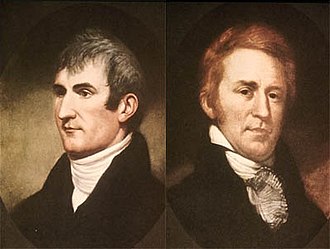
Meriwether Lewis and William Clark lead the Corps of Discovery westward from Camp Dubois into uncharted American territory.

The only member of the expedition to die on the entire journey is Sergeant Charles Floyd — almost certainly from a ruptured appendix, not any frontier peril.

The Lewis and Clark Expedition, also known as the Corps of Discovery Expedition, was the United States expedition to cross the newly acquired western portion of the country after the Louisiana Purchase. The Corps of Discovery was a select group of U.S. Army and civilian volunteers under the command of Captain Meriwether Lewis and his close friend Second Lieutenant William Clark. Clark, along with 30 others, set out from Camp Dubois, Illinois, on May 14, 1804, met Lewis and ten other members of the group in St. Charles, Missouri, then went up the Missouri River. The expedition crossed the Continental Divide of the Americas near the Lemhi Pass, eventually coming to the Columbia River, and the Pacific Ocean in 1805. The return voyage began on March 23, 1806, at Fort Clatsop, Oregon, ending six months later on September 23.

📷 Wikimedia Commons

1893

Norwegian explorer Fridtjof Nansen deliberately sails his ship Fram into the Arctic ice and lets it freeze solid.

His plan is to drift across the pole trapped in the ice — and his custom-built hull is so rounded that the ice simply squeezes it upward rather than crushing it.

Fridtjof Nansen's deliberate freezing of his ship Fram into Arctic ice proved that a transpolar current exists and set a new Farthest North record.

Play today's puzzle ▸