History puzzle · June 26, 2026

The industrial & modern age

Steam to silicon

Difficulty ★★★★ · 10 events

In Hand of History for June 26, 2026 you place these 10 real events back into the order they happened. Here they are in chronological order, with the date revealed and why each one matters.

Bessemer patents his steel process — 1856
1856

Henry Bessemer patents a new converter that mass-produces steel in minutes rather than days.

Bessemer, who has no formal training in metallurgy, invents the process while trying to improve cannon barrels for the Crimean War.

The Bessemer process was the first inexpensive industrial process for the mass production of steel from molten pig iron before the development of the open hearth furnace. The key principle is removal of impurities and undesired elements, primarily excess carbon, contained in the pig iron by oxidation with air being blown through the molten iron. Oxidation of the excess carbon also raises the temperature of the iron mass and keeps it molten. Virtually all the pig iron carbon is removed by the converter, and so carbon must be added at the end of the process to create steel. 0.25% carbon content is a typical value for low carbon steel which is used in construction and other low-stress applications.

📷 Wikimedia Commons

First transatlantic telegraph cable laid — 1866
1866

The SS Great Eastern successfully lays a working telegraph cable across the Atlantic Ocean floor.

Two earlier attempts in 1857 and 1858 both snapped — the 1858 cable worked for just three weeks before the insulation failed.

Transatlantic telegraph cables are undersea cables running under the Atlantic Ocean which were used for telegraph communications.

📷 Wikimedia Commons

Suez Canal opens — 1869
1869

Egypt opens the Suez Canal, linking the Mediterranean to the Red Sea.

The grand opening gala is so lavish it nearly bankrupts the Egyptian government — the Khedive spends the equivalent of millions hosting European royalty for days.

The Suez Canal is an artificial sea-level waterway in Egypt, connecting the Mediterranean Sea to the Red Sea through the Isthmus of Suez and dividing Africa and Asia. It is the border between Africa and Asia. The 193.30-kilometre-long (120.11 mi) canal is a key trade route between Europe and Asia.

📷 Wikimedia Commons

1901

Guglielmo Marconi claims to receive the first transatlantic radio signal at Signal Hill, Newfoundland.

The message is just the letter 'S' in Morse code — three faint dots — and many scientists of the day flatly refuse to believe him.

Guglielmo Marconi's transatlantic wireless signal proves radio waves can span entire oceans.

Panama Canal opens to shipping — 1914
1914

The Panama Canal opens, allowing ships to pass between the Atlantic and Pacific oceans through Central America.

The French tried first and abandoned the project after roughly 22,000 workers died, mostly from yellow fever and malaria.

The Panama Canal is an artificial 82-kilometer (51-mile) waterway in Panama that connects the Caribbean Sea with the Pacific Ocean. It cuts across the narrowest point of the Isthmus of Panama, and is a conduit for maritime trade between the Atlantic Ocean and the Pacific Ocean. Locks at each end lift ships up to Gatun Lake, an artificial fresh water lake 26 meters (85 ft) above sea level, created by damming the Chagres River and Lake Alajuela to reduce the amount of excavation work required for the canal. Locks then lower the ships at the other end. The original locks are 33.5 meters (110 ft) wide and allow the passage of Panamax ships. A third, wider lane of locks was constructed between September 2007 and May 2016. The expanded waterway began commercial operation on 26 June 2016. The new locks allow for the transit of larger, Neopanamax ships. An average of 200,000,000 litres of fresh water is used in a single passing of a ship. The canal is threatened by low water levels during droughts.

📷 Wikimedia Commons

First artificial nuclear chain reaction achieved — 1942
1942

Enrico Fermi's team achieves the first self-sustaining nuclear chain reaction beneath the stands of a Chicago squash court.

The only safety system is a bucket of cadmium-sulfate solution and an axe — one physicist stands ready to cut a rope to drop a control rod if things go wrong.

Chicago Pile-1 (CP-1) was the first artificial nuclear reactor. On 2 December 1942, the first human-made self-sustaining nuclear chain reaction was initiated in CP-1 during an experiment led by Enrico Fermi. The secret development of the reactor was the first major technical achievement for the Manhattan Project, the Allied effort to create nuclear weapons during World War II. Developed by the Metallurgical Laboratory at the University of Chicago, CP-1 was built under the west viewing stands of the original Stagg Field. Although the project's civilian and military leaders had misgivings about the possibility of a disastrous runaway reaction, they trusted Fermi's safety calculations and decided they could carry out the experiment in a densely populated area. Fermi described the reactor as "a crude pile of black bricks and wooden timbers".

📷 Wikimedia Commons

Trinity nuclear test detonated — 1945
1945

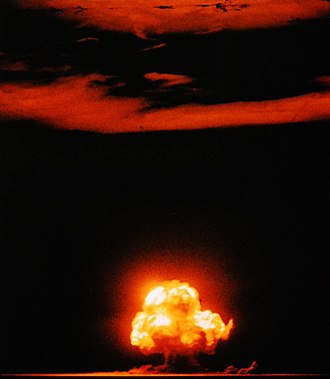
The world's first nuclear bomb is detonated at the Trinity test site in the New Mexico desert.

Director Robert Oppenheimer recalls a line from Hindu scripture — 'Now I am become Death' — but test director Kenneth Bainbridge simply says, 'Now we are all sons of bitches.'

Trinity was the first detonation of a nuclear weapon, conducted by the United States Army at 5:29 a.m. Mountain War Time on July 16, 1945, as part of the Manhattan Project. The test was of an implosion-design plutonium bomb, or "gadget" – the same design as the Fat Man bomb later detonated over Nagasaki, Japan, on August 9, 1945. Concerns about whether the complex Fat Man design would work led to a decision to conduct the first nuclear test. The code name "Trinity" was assigned by J. Robert Oppenheimer, the director of the Los Alamos Laboratory. The name was possibly inspired by the poetry of John Donne.

📷 Wikimedia Commons

First nuclear power plant opens — 1956
1956

Britain opens Calder Hall, the world's first full-scale commercial nuclear power station.

Queen Elizabeth II flips the switch to connect it to the grid — but the plant also secretly produces plutonium for Britain's nuclear weapons program.

Calder Hall Nuclear Power Station is a former Magnox nuclear power station on the Sellafield site in Cumbria in North West England. Calder Hall was the first full-scale nuclear power station to enter operation in the West, and was the sister plant to the Chapelcross plant in Scotland. Both were commissioned and originally operated by the United Kingdom Atomic Energy Authority. The primary purpose of both plants was to produce weapons-grade plutonium for the UK's nuclear weapons programme, but they also generated electrical power for the National Grid.

📷 Wikimedia Commons

Berlin Wall falls — 1989
1989

East Germany opens its borders and jubilant crowds begin tearing down the Berlin Wall by hand.

The announcement that triggers the stampede is made by a flustered East German spokesman who misread his briefing notes and says the borders are open 'immediately, without delay.'

The Berlin Wall fell on 9 November 1989 during the Peaceful Revolution, marking the beginning of the destruction of the figurative Iron Curtain, as East Berlin transit restrictions were overwhelmed and discarded. Sections of the wall were breached, and planned deconstruction began the following June. It was one of the series of events that started the fall of communism in Central and Eastern Europe. The fall of the inner German border took place shortly afterward. An end to the Cold War was declared at the Malta Summit in early December, and German reunification took place in October the following year.

📷 Wikimedia Commons

World Wide Web goes public — 1991
1991

Tim Berners-Lee makes the World Wide Web publicly available, posting its first website from a lab in Geneva.

His boss at CERN initially returns the original web proposal with a note reading 'vague but exciting' — and nearly shelves it entirely.

The World Wide Web is a global interconnected information system that enables content sharing over the Internet. It facilitates access to documents and other web resources according to specific rules of the Hypertext Transfer Protocol (HTTP).

📷 Wikimedia Commons

Play today's puzzle ▸