History puzzle · June 23, 2026

Voyages & exploration

Charting the unknown

Difficulty ★★☆☆☆ · 10 events

In Hand of History for June 23, 2026 you place these 10 real events back into the order they happened. Here they are in chronological order, with the date revealed and why each one matters.

Leif Erikson reaches Vinland — 1000
1000

Norse explorer Leif Erikson sails west from Greenland and makes landfall in a place he calls Vinland.

The settlement his crew builds is so small that archaeologists find the entire site in a single Canadian field at L'Anse aux Meadows — eight turf buildings.

Vinland, Vineland, or Winland was an area of coastal North America explored by Vikings. Leif Erikson landed there around AD 1000, nearly five centuries before the voyages of Christopher Columbus and John Cabot. The name appears in the Vinland sagas and describes a land beyond Greenland, Helluland, and Markland. Much of the geographical content of the sagas corresponds to present-day knowledge of transatlantic travel and North America.

📷 Wikimedia Commons

Ibn Battuta begins his travels — 1325
1325

Moroccan scholar Ibn Battuta departs Tangier for Mecca on what he expects to be a single pilgrimage.

He never really goes home — the trip expands for 29 years and crosses 44 modern countries.

Ibn Battuta was a Maghrebi Muslim traveller, explorer and scholar from Tangier. Over a period of 30 years from 1325 to 1354, he visited much of Africa, Asia, and the Iberian Peninsula. Near the end of his life, Ibn Battuta dictated an account of his journeys, titled A Gift to Those Who Contemplate the Wonders of Cities and the Marvels of Travelling, commonly known as The Rihla. Ibn Battuta travelled more than any other explorer in pre-modern history, totalling around 117,000 km (73,000 mi), surpassing Zheng He with about 50,000 km (31,000 mi) and Marco Polo with 24,000 km (15,000 mi).

📷 Wikimedia Commons

Dias rounds the Cape of Good Hope — 1488
1488

Portuguese navigator Bartolomeu Dias rounds the southern tip of Africa, becoming the first European to do so.

He originally names it Cabo das Tormentas — the Cape of Storms — but King João II renames it to sound more optimistic for investors.

Bartolomeu Dias was a Portuguese mariner and explorer. In February 1488, he became the first European navigator to round the southern tip of Africa and to demonstrate that the most effective southward route for ships is in the open ocean, well to the west of the African coast. His discoveries were later used by Vasco da Gama to establish a sea route between Europe and Asia.

📷 Wikimedia Commons

Cabot claims North America for England — 1497
1497

Venetian-born explorer John Cabot, sailing under English colors, makes landfall on the North American mainland.

Henry VII rewards him with a one-off payment of just £10 — roughly the wages of a skilled craftsman for a year.

John Cabot was an Italian navigator and explorer. His 1497 voyage to the coast of North America under the commission of Henry VII, King of England is the earliest known European exploration of coastal North America since the Norse visits to Vinland in the eleventh century. To mark the celebration of the 500th anniversary of Cabot's expedition, both the Canadian and British governments declared Cape Bonavista, Newfoundland as representing Cabot's first landing site. However, alternative locations have also been proposed.

📷 Wikimedia Commons

Cabot reaches North America — 1497
1497

John Cabot sails west from Bristol and becomes the first European since the Norse to set foot on mainland North America.

He returns to England convinced he has reached Asia — and Henry VII rewards his world-changing voyage with a one-off payment of just £10.

John Cabot was an Italian navigator and explorer. His 1497 voyage to the coast of North America under the commission of Henry VII, King of England is the earliest known European exploration of coastal North America since the Norse visits to Vinland in the eleventh century. To mark the celebration of the 500th anniversary of Cabot's expedition, both the Canadian and British governments declared Cape Bonavista, Newfoundland as representing Cabot's first landing site. However, alternative locations have also been proposed.

📷 Wikimedia Commons

Champlain founds Quebec City — 1608
1608

Samuel de Champlain establishes a permanent French trading post at a narrow point on the St. Lawrence River, calling it Québec.

Of the 28 men who winter there the first year, 20 die of scurvy and dysentery — and Champlain uncovers a murder plot among the survivors.

Samuel de Champlain was a French explorer, navigator, cartographer, soldier, geographer, diplomat, and chronicler who founded Quebec City and established New France as a permanent French colony in North America.

📷 Wikimedia Commons

Tasman sights New Zealand — 1642
1642

Dutch navigator Abel Tasman becomes the first European to sight New Zealand, which he charts as a possible edge of a great southern continent.

His very first encounter with Māori ends in four Dutch sailors being killed by a war canoe — so he sails away without ever setting foot on shore.

Abel Janszoon Tasman was a Dutch seafarer and explorer, best known for his voyages of 1642 and 1644 in the service of the Dutch East India Company (VOC). He was the first European to reach New Zealand, which he named Staten Landt. He also discovered and was the eponym of Tasmania.

📷 Wikimedia Commons

Bering sights Alaska — 1741
1741

Danish-born Russian explorer Vitus Bering sights the Alaskan coast, the first confirmed European contact with northwestern North America.

Bering himself dies of scurvy on the return voyage, shipwrecked on the island that now bears his name, spending his final days half-buried in sand for warmth.

Vitus Jonassen Bering, also known as Ivan Ivanovich Bering, was a Danish-born Russian cartographer, explorer, and officer in the Russian Navy. He is known as a leader of two Russian expeditions, the First Kamchatka Expedition and the Great Northern Expedition, exploring the northeastern coast of the Asian continent and from there the western coast of the North American continent. The Bering Strait, the Bering Sea, Bering Island, the Bering Glacier, and Vitus Lake were all named in his honor.

📷 Wikimedia Commons

Cook's first Pacific voyage sets sail — 1768
1768

Royal Navy lieutenant James Cook departs Plymouth aboard HMS Endeavour on a scientific voyage to Tahiti to observe the transit of Venus.

The ship is a converted collier — a humble coal-hauling barge — chosen precisely because its flat bottom can be beached for repairs on unknown shores.

The first voyage of James Cook was a combined Royal Navy and Royal Society expedition to the south Pacific Ocean aboard HMS Endeavour, from 1768 to 1771. The aims were to observe the 1769 transit of Venus from Tahiti and to seek evidence of the postulated Terra Australis Incognita or "undiscovered southern land". It was the first of three voyages of which Cook was the commander.

📷 Wikimedia Commons

Lewis and Clark expedition departs — 1804
1804

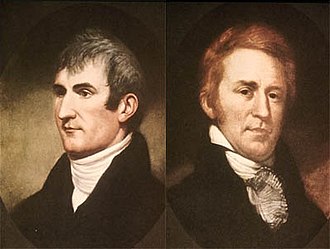
Meriwether Lewis and William Clark lead the Corps of Discovery westward from Camp Dubois to explore the newly acquired Louisiana Territory.

The Corps carries a remarkable piece of kit: an air rifle that fires 22 shots without reloading, which they deliberately demonstrate to every Native nation they meet to imply their firepower is limitless.

The Lewis and Clark Expedition, also known as the Corps of Discovery Expedition, was the United States expedition to cross the newly acquired western portion of the country after the Louisiana Purchase. The Corps of Discovery was a select group of U.S. Army and civilian volunteers under the command of Captain Meriwether Lewis and his close friend Second Lieutenant William Clark. Clark, along with 30 others, set out from Camp Dubois, Illinois, on May 14, 1804, met Lewis and ten other members of the group in St. Charles, Missouri, then went up the Missouri River. The expedition crossed the Continental Divide of the Americas near the Lemhi Pass, eventually coming to the Columbia River, and the Pacific Ocean in 1805. The return voyage began on March 23, 1806, at Fort Clatsop, Oregon, ending six months later on September 23.

📷 Wikimedia Commons

Play today's puzzle ▸