History puzzle · June 22, 2026

Ancient wonders & empires

The deep past

Difficulty ☆☆☆☆ · 10 events

In Hand of History for June 22, 2026 you place these 10 real events back into the order they happened. Here they are in chronological order, with the date revealed and why each one matters.

Cyrus the Great founds the Achaemenid Empire — 550 BC
550 BC

Cyrus the Great defeats the Median king Astyages and founds the Achaemenid Persian Empire.

Unlike most conquerors, Cyrus lets the defeated Medes keep their customs, titles, and even their court roles — making his new empire unusually hard to rebel against.

Cyrus II of Persia, commonly known as Cyrus the Great, was the founder of the Achaemenid Empire. Hailing from Persis, he brought the Achaemenid dynasty to power by defeating the Median Empire and embracing all of the previous civilized states of the ancient Near East, expanding vastly across most of West Asia and much of Central Asia to create what would soon become the largest empire in history at the time. The Achaemenid Empire's greatest territorial extent was achieved under Darius the Great, whose rule stretched from Southeast Europe and Northeast Africa in the west to the Indus Valley in the east.

📷 Wikimedia Commons
539 BC

Persian king Cyrus the Great captures Babylon without a battle, walking through its gates unopposed.

He promptly frees the Jewish exiles held there and lets them carry their sacred temple vessels home — a decree he records on a clay cylinder still displayed in the British Museum.

Cyrus the Great's bloodless conquest of Babylon creates the largest empire the world had yet seen and sets a new standard for tolerant rule.

399 BC

The Athenian court sentences philosopher Socrates to death by hemlock for impiety and corrupting the youth.

Socrates refuses a well-organized escape plan arranged by his friend Crito, insisting that fleeing would contradict the very principles of justice he had preached.

The Trial of Socrates was held to determine the philosopher's guilt of two charges against the city of Athens: asebeia (impiety) and corruption of the youth. The accusers cited two impious acts: "failing to acknowledge the gods of the city" and "introducing new deities".

331 BC

Alexander the Great personally marks out the street grid of his new city, Alexandria, on the Egyptian coast.

Legend aside, ancient sources record he uses grain to draw the boundaries — and birds immediately swoop down and eat it, which his seers hastily reinterpret as a good omen.

Alexander the Great personally lays out the city plan of Alexandria, Egypt, which will become the ancient world's greatest center of learning.

Lighthouse of Alexandria rises — 280 BC
280 BC

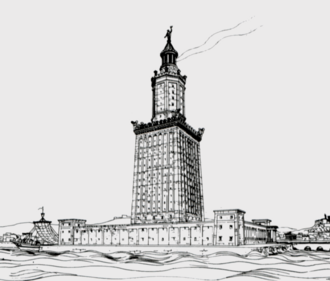
Workers complete the great Lighthouse of Alexandria on the island of Pharos, off the Egyptian coast.

The architect Sostratus of Cnidus reportedly hides his own name in an inscription beneath the plaster dedicating the monument to Ptolemy — ensuring history would remember him once the plaster crumbled.

The Lighthouse of Alexandria, sometimes called the Pharos of Alexandria, was a lighthouse built by the Ptolemaic Kingdom of Ancient Egypt, during the reign of Ptolemy II Philadelphus. It has been estimated to have been at least 100 metres (330 ft) in overall height. One of the Seven Wonders of the Ancient World, for many centuries it was one of the world's tallest man-made structures.

📷 Wikimedia Commons

Rome and Carthage clash in the First Punic War — 264 BC
264 BC

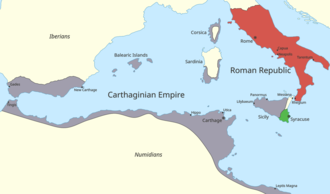
Rome and Carthage go to war over the island of Sicily in the First Punic War.

Rome has no real navy at the start, so it copies a captured Carthaginian warship plank by plank and reportedly builds 100 vessels while training its rowers on benches on dry land.

The First Punic War was the first of three wars fought between Rome and Carthage, the two main powers of the western Mediterranean in the early 3rd century BC. For 23 years, in the longest continuous conflict and greatest naval war of antiquity, the two powers struggled for supremacy. The war was fought primarily on the Mediterranean island of Sicily and its surrounding waters, and also in North Africa. After immense losses on both sides, the Carthaginians were defeated and Rome gained territory from Carthage.

📷 Wikimedia Commons

146 BC

Roman forces under Scipio Aemilianus raze Carthage to the ground, ending the Third Punic War.

The Roman senator Cato had ended every speech for years — on any topic whatsoever — with the words "Carthage must be destroyed."

Rome's total destruction of Carthage at the end of the Third Punic War eliminates its greatest rival and cements its dominance over the Mediterranean world.

49 BC

Julius Caesar leads his Thirteenth Legion across the Rubicon River into Italy, defying the Roman Senate.

Roman law strictly forbids a general from bringing armed troops across this boundary — Caesar's reported words are 'the die is cast,' a gambler's phrase that becomes a byword for bold irreversible action.

The phrase "crossing the Rubicon" is an idiom meaning "passing the point of no return". Its meaning comes from the crossing of the Rubicon river by Julius Caesar in January 49 BC at the head of the 13th Legion. Caesar was not allowed to command an army within Italy proper, and by crossing the river with his forces was defying law and risking death. The crossing precipitated a civil war, which eventually led to Caesar becoming dictator for life.

Vesuvius buries Pompeii — 79
79

Mount Vesuvius erupts and buries the Roman city of Pompeii under metres of ash and pumice.

Pliny the Younger watches the whole disaster from across the bay and writes such precise letters describing it that volcanologists still use 'Plinian eruption' as a technical term today.

In 79 AD, Mount Vesuvius, a stratovolcano located in the modern-day region of Campania, Italy, erupted, causing one of the deadliest eruptions in history. Vesuvius violently ejected a cloud of super-heated tephra and gases to a height of 33 km (21 mi), ejecting molten rock, pulverized pumice and hot ash at 1.5 million tons per second, ultimately releasing 100,000 times the thermal energy of the atomic bombings of Hiroshima and Nagasaki. The event gives its name to the Vesuvian type of volcanic eruption, characterised by columns of hot gases and ash reaching the stratosphere, although the event also included pyroclastic flows associated with Peléan eruptions.

📷 Wikimedia Commons

Constantine issues the Edict of Milan — 313
313

Emperor Constantine and co-emperor Licinius issue the Edict of Milan, granting religious freedom throughout the Roman Empire.

The edict does not make Christianity the official religion — it legalises all religions equally, including the old Roman cults that Christians had been fighting for centuries.

The Edict of Milan was the 13 February 313 AD agreement to treat Christians benevolently within the Roman Empire. Western Roman Emperor Constantine I and Emperor Licinius, who controlled the Balkans, met in Mediolanum and, among other things, agreed to change policies towards Christians following the edict of toleration issued by Emperor Galerius two years earlier in Serdica. The Edict of Milan gave Christianity legal status and a reprieve from persecution but did not make it the state church of the Roman Empire, which occurred in AD 380 with the Edict of Thessalonica, when Nicene Christianity received normative status.

📷 Wikimedia Commons

Play today's puzzle ▸