History puzzle · June 19, 2026

The industrial & modern age

Steam to silicon

Difficulty ★★★★ · 10 events

In Hand of History for June 19, 2026 you place these 10 real events back into the order they happened. Here they are in chronological order, with the date revealed and why each one matters.

Bessemer patents his steel process — 1856
1856

Henry Bessemer patents a converter that mass-produces steel by blasting air through molten iron.

Bessemer himself has no metallurgy training — he stumbles onto the process while trying to make a better artillery shell.

The Bessemer process was the first inexpensive industrial process for the mass production of steel from molten pig iron before the development of the open hearth furnace. The key principle is removal of impurities and undesired elements, primarily excess carbon, contained in the pig iron by oxidation with air being blown through the molten iron. Oxidation of the excess carbon also raises the temperature of the iron mass and keeps it molten. Virtually all the pig iron carbon is removed by the converter, and so carbon must be added at the end of the process to create steel. 0.25% carbon content is a typical value for low carbon steel which is used in construction and other low-stress applications.

📷 Wikimedia Commons

1858

Queen Victoria and U.S. President Buchanan exchange congratulatory telegrams across the first transatlantic cable.

The cable fails after just three weeks of use, sending its last signal on September 1st after the insulation is damaged by excessive voltage.

The first transatlantic telegraph cable lets Europe and North America exchange messages in minutes rather than weeks by ship.

Suez Canal opens — 1869
1869

Egypt opens the Suez Canal, linking the Mediterranean Sea to the Red Sea.

The grand opening gala is so expensive — with purpose-built palaces for royal guests — that it helps push Egypt into bankruptcy within a decade.

The Suez Canal is an artificial sea-level waterway in Egypt, connecting the Mediterranean Sea to the Red Sea through the Isthmus of Suez and dividing Africa and Asia. It is the border between Africa and Asia. The 193.30-kilometre-long (120.11 mi) canal is a key trade route between Europe and Asia.

📷 Wikimedia Commons

Paris Commune seizes power — 1871
1871

Parisian workers and National Guard members seize control of the city and declare the Paris Commune.

Before it falls, the Communards topple the Vendôme Column — a symbol of Napoleonic imperialism — and the painter Gustave Courbet is blamed and billed for its reconstruction.

The Paris Commune was a French revolutionary government that seized power in Paris on 18 March 1871 and controlled parts of the city until 28 May 1871. During the Franco-Prussian War of 1870–1871, the French National Guard had defended Paris, and working class radicalism grew among its soldiers. Following the establishment of the French Third Republic in September 1870 and the complete defeat of the French Army by the Germans by March 1871, soldiers of the National Guard seized control of the city on 18 March. The Communards killed two French Army generals and refused to accept the authority of the Third Republic; instead, the radicals set about establishing their own independent government.

📷 Wikimedia Commons

1901

Guglielmo Marconi transmits the first wireless radio signal across the Atlantic Ocean, from Cornwall to Newfoundland.

The message is just the Morse code letter 'S' — three dots — chosen because it's the simplest signal possible to confirm reception.

Guglielmo Marconi's wireless signal crosses the Atlantic, proving that radio waves could span oceans and transforming global communication forever.

Panama Canal opens to shipping — 1914
1914

The Panama Canal officially opens, allowing ships to pass between the Atlantic and Pacific oceans through Central America.

The first vessel to make the full transit is not a grand ocean liner but a humble cement boat, the SS Cristóbal.

The Panama Canal is an artificial 82-kilometer (51-mile) waterway in Panama that connects the Caribbean Sea with the Pacific Ocean. It cuts across the narrowest point of the Isthmus of Panama, and is a conduit for maritime trade between the Atlantic Ocean and the Pacific Ocean. Locks at each end lift ships up to Gatun Lake, an artificial fresh water lake 26 meters (85 ft) above sea level, created by damming the Chagres River and Lake Alajuela to reduce the amount of excavation work required for the canal. Locks then lower the ships at the other end. The original locks are 33.5 meters (110 ft) wide and allow the passage of Panamax ships. A third, wider lane of locks was constructed between September 2007 and May 2016. The expanded waterway began commercial operation on 26 June 2016. The new locks allow for the transit of larger, Neopanamax ships. An average of 200,000,000 litres of fresh water is used in a single passing of a ship. The canal is threatened by low water levels during droughts.

📷 Wikimedia Commons

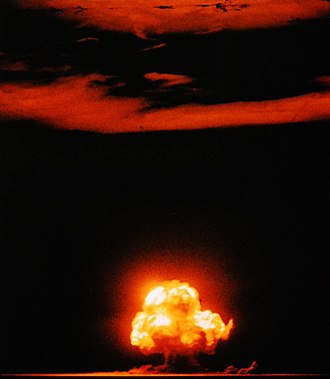
Trinity nuclear test detonated — 1945
1945

The U.S. Army detonates the world's first nuclear device at Trinity site in the New Mexico desert.

Project director J. Robert Oppenheimer recalls the Hindu scripture 'Now I am become Death' — but test director Kenneth Bainbridge's actual words are simply, 'Now we are all sons of bitches.'

Trinity was the first detonation of a nuclear weapon, conducted by the United States Army at 5:29 a.m. Mountain War Time on July 16, 1945, as part of the Manhattan Project. The test was of an implosion-design plutonium bomb, or "gadget" – the same design as the Fat Man bomb later detonated over Nagasaki, Japan, on August 9, 1945. Concerns about whether the complex Fat Man design would work led to a decision to conduct the first nuclear test. The code name "Trinity" was assigned by J. Robert Oppenheimer, the director of the Los Alamos Laboratory. The name was possibly inspired by the poetry of John Donne.

📷 Wikimedia Commons

Apollo 11 lands on the Moon — 1969
1969

Neil Armstrong and Buzz Aldrin land on the Moon while Michael Collins orbits above in the command module.

Armstrong has to fly the lander manually past a boulder-strewn crater with only about 25 seconds of fuel to spare.

Apollo 11 was the American spaceflight that first landed humans on the Moon, and the fifth crewed mission of NASA's Apollo program. The mission was crewed by Commander Neil Armstrong, Command Module Pilot Michael Collins, and Lunar Module Pilot Edwin "Buzz" Aldrin, all of whom were on their second and final spaceflight.

📷 Wikimedia Commons

Berlin Wall falls — 1989
1989

East Germany opens its borders and crowds of Berliners begin tearing down the Wall with hammers and picks.

The opening happens by accident: spokesman Günter Schabowski announces the new travel rules live on TV without knowing they were meant to take effect the next day.

The Berlin Wall fell on 9 November 1989 during the Peaceful Revolution, marking the beginning of the destruction of the figurative Iron Curtain, as East Berlin transit restrictions were overwhelmed and discarded. Sections of the wall were breached, and planned deconstruction began the following June. It was one of the series of events that started the fall of communism in Central and Eastern Europe. The fall of the inner German border took place shortly afterward. An end to the Cold War was declared at the Malta Summit in early December, and German reunification took place in October the following year.

📷 Wikimedia Commons

1991

Tim Berners-Lee opens the World Wide Web to the public, posting the first website on a NeXT computer at CERN.

He sticks a note on that computer reading 'This machine is a server — DO NOT POWER IT DOWN,' saving the entire web from accidental deletion.

Tim Berners-Lee makes the World Wide Web publicly available, fundamentally transforming how humanity accesses and shares information.

Play today's puzzle ▸