History puzzle · June 18, 2026

Revolutions & independence

When people remade their nations

Difficulty ★★★☆☆ · 10 events

In Hand of History for June 18, 2026 you place these 10 real events back into the order they happened. Here they are in chronological order, with the date revealed and why each one matters.

Dutch defy the Spanish crown — 1581
1581

The Dutch States-General signs the Act of Abjuration, declaring independence from Philip II of Spain.

The document explicitly argues that a king who acts like a tyrant forfeits his throne — a radical legal idea at the time.

The Act of Abjuration is the declaration of independence by many of the provinces of the Netherlands from their allegiance to Philip II of Spain, during the Dutch Revolt.

📷 Wikimedia Commons

England's bloodless revolution — 1688
1688

William of Orange lands in England with an army, and King James II flees to France without a battle.

William's fleet is so enormous that it takes three hours to pass any given point on the English coast.

The Glorious Revolution was the deposition of King James II in November 1688. He was replaced by his daughter Mary II and her Dutch husband, James's nephew William III of Orange. The two ruled as joint monarchs of England, Scotland, and Ireland until Mary's death in 1694, when William became ruler in his own right. Jacobitism, the political movement that aimed to restore the exiled James or his descendants of the House of Stuart to the throne, persisted into the late 18th century. Some historians consider it the last successful invasion of England.

📷 Wikimedia Commons

Shot heard 'round the world — 1775
1775

Colonial militiamen and British redcoats exchange fire at Lexington and Concord, Massachusetts.

Nobody knows who fired first — both sides blame the other — and the mystery is never solved.

The Battles of Lexington and Concord on April 19, 1775, were the first major military actions between the British Army and Patriot militias from British America's Thirteen Colonies during the American Revolutionary War. The opposing forces fought day-long running battles in Middlesex County in the Province of Massachusetts Bay, in the towns of Lexington, Concord, Lincoln, Menotomy, and Cambridge.

📷 Wikimedia Commons

U.S. Constitution ratified — 1788
1788

New Hampshire becomes the ninth state to ratify the U.S. Constitution, making it the law of the land.

The Constitution contains no mention of political parties — the Founders considered them dangerous factions.

The United States Constitution has served as the supreme law of the United States since taking effect in 1789. The document was written at the 1787 Philadelphia Convention and was ratified through a series of state conventions held in 1787 and 1788. Since 1789, the Constitution has been amended twenty-seven times; particularly important amendments include the ten amendments of the United States Bill of Rights, the three Reconstruction Amendments, and the Nineteenth Amendment.

📷 Wikimedia Commons

Mexico rings for independence — 1810
1810

Parish priest Miguel Hidalgo rings his church bell in Dolores and delivers a fiery speech urging rebellion against Spain.

No reliable transcript of the speech survives — modern versions are reconstructions written decades after the fact.

The Cry of Dolores occurred in Dolores, Mexico, on 16 September 1810, when Roman Catholic priest Miguel Hidalgo y Costilla rang his church bell and gave the call to arms that triggered the Mexican War of Independence. The Cry of Dolores is most commonly known by the locals as El Grito de Independencia.

📷 Wikimedia Commons

Brazil breaks from Portugal — 1822
1822

Prince Pedro of Portugal proclaims Brazilian independence beside the Ipiranga River, shouting 'Independence or death!'

Pedro is reportedly returning from the toilet — mid-journey from São Paulo — when the news from Lisbon arrives and forces his decision.

The independence of Brazil began after a series of political and military events that led the Kingdom of Brazil to separate from the United Kingdom of Portugal, Brazil and the Algarves. It is celebrated on 7 September, the date in 1822 when prince regent Pedro of Braganza, beside the Ipiranga brook, declared independence from Portugal – a declaration that became known as the Cry of Ipiranga. Formal recognition by Portugal came with the Treaty of Rio de Janeiro, signed in 1825.

📷 Wikimedia Commons

Europe erupts in revolution — 1848
1848

A wave of liberal and nationalist uprisings sweeps France, Austria, Prussia, and dozens of other European states in a single year.

Nearly every revolution fails within two years, yet nearly every demand the revolutionaries made — constitutions, abolition of serfdom, press freedom — is quietly adopted within a generation.

The revolutions of 1848, also known as the springtime of the peoples, were a series of revolutions throughout Europe that spanned almost two years, between January 1848 and October 1849. They remain the most widespread revolutionary wave in European history to date.

📷 Wikimedia Commons

Paris Commune takes power — 1871
1871

Parisian workers seize control of the city and establish the Commune, an elected radical municipal government.

The Communards demolish the Vendôme Column — a monument to Napoleon — in a ceremony attended by the painter Gustave Courbet, who later gets the bill for rebuilding it.

The Paris Commune was a French revolutionary government that seized power in Paris on 18 March 1871 and controlled parts of the city until 28 May 1871. During the Franco-Prussian War of 1870–1871, the French National Guard had defended Paris, and working class radicalism grew among its soldiers. Following the establishment of the French Third Republic in September 1870 and the complete defeat of the French Army by the Germans by March 1871, soldiers of the National Guard seized control of the city on 18 March. The Communards killed two French Army generals and refused to accept the authority of the Third Republic; instead, the radicals set about establishing their own independent government.

📷 Wikimedia Commons

Tsar Nicholas II abdicates — 1917
1917

Mass bread riots and army mutinies in Petrograd force Tsar Nicholas II to abdicate the Russian throne.

Nicholas initially tries to abdicate in favour of his son Alexei, but changes his mind mid-document and names his brother Michael instead — who refuses the crown the next day.

The February Revolution, known in Soviet historiography as the February Bourgeois Democratic Revolution, and sometimes as the March Revolution, was the first of two revolutions which took place in Russia in 1917.

📷 Wikimedia Commons

Mao proclaims the People's Republic — 1949
1949

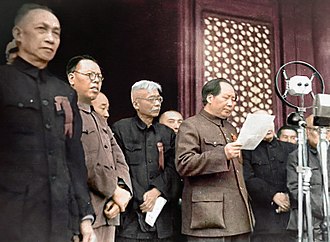
Mao Zedong stands atop Tiananmen Gate in Beijing and proclaims the founding of the People's Republic of China.

The Nationalist government he defeats retreats to Taiwan with China's entire gold reserve and most of its air force and navy.

The People's Republic of China was proclaimed by Mao Zedong, the chairman of the Chinese Communist Party (CCP), on October 1, 1949, in Tiananmen Square in Beijing. The government of a new state under the CCP, formally called the Central People's Government, was proclaimed by Mao at the ceremony, which marked the foundation of contemporary China.

📷 Wikimedia Commons

Play today's puzzle ▸