History puzzle · June 14, 2026

Mixed eras

A little of everything

Difficulty ★★☆☆☆ · 10 events

In Hand of History for June 14, 2026 you place these 10 real events back into the order they happened. Here they are in chronological order, with the date revealed and why each one matters.

First Olympic Games held — 776 BC
776 BC

Greek athletes compete in the first Olympic Games at the sanctuary of Olympia.

The only event is a 192-metre foot race — roughly one length of the stadium — won by a cook named Coroebus.

The ancient Olympic Games, or the ancient Olympics, were a series of athletic competitions among representatives of city-states and one of the Panhellenic Games of ancient Greece. They were held at the Panhellenic religious sanctuary of Olympia, in honor of Zeus, and the Greeks gave them a mythological origin. The originating Olympic Games are traditionally dated to 776 BC. The games were held every four years, or Olympiad, which became a unit of time in historical chronologies. These Olympiads were referred to based on the winner of their stadion sprint, e.g., "the third year of the eighteenth Olympiad when Ladas of Argos won the stadion". They continued to be celebrated when Greece came under Roman rule in the 2nd century BC. Their last recorded celebration was in AD 393, under the emperor Theodosius I, but archaeological evidence indicates that some games were still held after this date. The games likely came to an end under Theodosius II, possibly in connection with a fire that burned down the temple of the Olympian Zeus during his reign.

📷 Wikimedia Commons

Caesar assassinated — 44 BC
44 BC

Roman senators stab Julius Caesar to death on the floor of the Theatre of Pompey.

Caesar is stabbed 23 times, but the autopsy later concludes only one wound was actually fatal.

Julius Caesar, the Roman dictator, was assassinated on the Ides of March, 44 BC, by a group of senators during a Senate session at the Curia of Pompey, located within the Theatre of Pompey in Rome. The conspirators, numbering 60 individuals and led by Marcus Junius Brutus, Gaius Cassius Longinus, and Decimus Junius Brutus Albinus, stabbed Caesar approximately 23 times. They justified the act as a preemptive defense of the Roman Republic, asserting that Caesar's accumulation of lifelong political authority—including his perpetual dictatorship and other honors—threatened republican traditions. The assassination failed to achieve its immediate objective of restoring the Republic's institutions. Instead, it precipitated Caesar's posthumous deification, triggered the Liberators' civil war between his supporters and the conspirators, and contributed to the collapse of the Republic. These events ultimately culminated in the rise of the Roman Empire under Augustus, marking the beginning of the Principate era.

📷 Wikimedia Commons

Charlemagne crowned emperor — 800
800

Pope Leo III crowns Charlemagne emperor of the Romans in St. Peter's Basilica on Christmas Day.

Charlemagne later claims he never would have entered the church that morning had he known the Pope intended to crown him.

Charlemagne was King of the Franks from 768, King of the Lombards from 774, and Emperor of what is now known as the Carolingian Empire from 800. He united most of Western and Central Europe and was the first recognised emperor to rule from the west after the fall of the Western Roman Empire approximately three centuries earlier. Charlemagne's reign was marked by political and social changes that had lasting influence on Europe throughout the Middle Ages.

📷 Wikimedia Commons

Magna Carta sealed — 1215
1215

English barons force King John to seal the Magna Carta at Runnymede.

John immediately writes to the Pope to have it annulled, and the Pope obliges — within ten weeks.

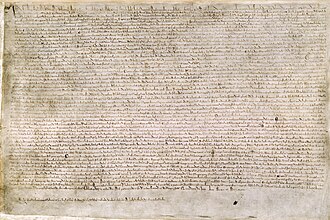
Magna Carta, sometimes spelled Magna Charta, is a royal charter of rights sealed by King John of England at Runnymede, near Windsor, on 15 June 1215. First drafted by the Archbishop of Canterbury, Cardinal Stephen Langton, to make peace between the unpopular king and a group of rebel barons who demanded that the King confirm the Charter of Liberties, it promised the protection of church rights, protection for the barons from illegal imprisonment, access to swift and impartial justice, and limitations on feudal payments to the Crown, to be implemented through a council of 25 barons. Neither side stood by their commitments, and the charter was annulled by Pope Innocent III, leading to the First Barons' War.

📷 Wikimedia Commons

Gutenberg prints the Bible — 1455
1455

Johannes Gutenberg produces the first printed Bible using his new movable-type press in Mainz.

To avoid scaring off buyers, he prints fake handwritten flourishes on the margins so it looks like a manuscript.

The Gutenberg Bible, also known as the 42-line Bible, the Mazarin Bible or the B42, is the earliest major book printed in Europe using mass-produced metal movable type. It marked the start of the "Gutenberg Revolution" and the age of printed books in the West. The book is valued and revered for its high aesthetic and artistic qualities and its historical significance.

📷 Wikimedia Commons

Columbus reaches the Americas — 1492
1492

Christopher Columbus makes landfall in the Bahamas, believing he has reached Asia.

He is so convinced he's in the Indies that he calls the people he meets 'Indians' — a misnomer that sticks for centuries.

Between 1492 and 1504, the Italian explorer and navigator Christopher Columbus led four Spanish transatlantic maritime expeditions in the name of the Catholic Monarchs to the Americas. These voyages led to Europeans learning about the New World. This was an early breakthrough in the period known in Europe as the Age of Exploration, which saw the colonization of the Americas, a related biological exchange, and trans-Atlantic trade. These events, the effects and consequences of which persist to the present, are often cited as the beginning of the modern era.

📷 Wikimedia Commons

Newton publishes the Principia — 1687
1687

Isaac Newton publishes his Principia Mathematica, laying out the laws of motion and universal gravitation.

The entire print run is funded by astronomer Edmond Halley — because the Royal Society had already spent its budget on a book about fish.

Philosophiæ Naturalis Principia Mathematica, often called simply the Principia, is a book by Sir Isaac Newton that expounds Newton's laws of motion and his law of universal gravitation.

📷 Wikimedia Commons

Storming of the Bastille — 1789
1789

Parisian crowds storm the Bastille fortress, triggering the French Revolution.

The fearsome prison holds just seven inmates that day — four forgers, two 'lunatics,' and one aristocrat jailed at his family's request.

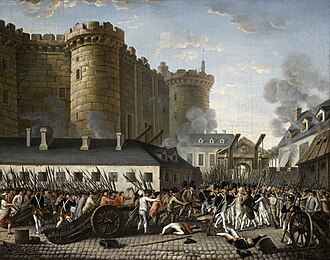
The Storming of the Bastille, which occurred in Paris, France, on 14 July 1789, was an act of political violence by revolutionary insurgents who attempted to storm and seize control of the medieval armoury, fortress, and political prison known as the Bastille. After four hours of fighting and 94 deaths, the insurgents were able to enter the Bastille. The governor of the Bastille, Bernard-René Jourdan de Launay, and several members of the garrison were killed after surrendering. At the time, the Bastille represented royal authority in the centre of Paris. The prison contained only seven inmates at the time of its storming and was already scheduled for demolition but was seen by the revolutionaries as a symbol of the monarchy's abuse of power. Its fall was the flashpoint of the French Revolution.

📷 Wikimedia Commons

Wright brothers achieve flight — 1903
1903

Orville Wright pilots the Flyer for 12 seconds above the sand dunes of Kitty Hawk, North Carolina.

The brothers flip a coin to decide who flies first — Wilbur wins but crashes on his attempt, so Orville gets the historic ride.

The Wright brothers, Orville Wright and Wilbur Wright, were American aviation pioneers generally credited with inventing, building, and flying the world's first successful airplane. They made the first controlled, sustained flight of an engine-powered, heavier-than-air aircraft with the Wright Flyer on December 17, 1903, four miles (6 km) south of Kitty Hawk, North Carolina, at what is now known as Kill Devil Hills. In 1904 the Wright brothers developed the Wright Flyer II, which made longer-duration flights including the first circle, followed in 1905 by the first truly practical fixed-wing aircraft, the Wright Flyer III.

📷 Wikimedia Commons

Apollo 11 lands on the Moon — 1969
1969

Neil Armstrong and Buzz Aldrin land on the Moon while Michael Collins orbits above, alone.

Collins later jokes that he was 'the loneliest man in the universe,' separated from all other humans by 2,000 miles of empty space.

Apollo 11 was the American spaceflight that first landed humans on the Moon, and the fifth crewed mission of NASA's Apollo program. The mission was crewed by Commander Neil Armstrong, Command Module Pilot Michael Collins, and Lunar Module Pilot Edwin "Buzz" Aldrin, all of whom were on their second and final spaceflight.

📷 Wikimedia Commons

Play today's puzzle ▸