History puzzle · June 13, 2026

20th-century firsts

The tightly-packed century

Difficulty ★★★★★ · 10 events

In Hand of History for June 13, 2026 you place these 10 real events back into the order they happened. Here they are in chronological order, with the date revealed and why each one matters.

Lindbergh crosses the Atlantic — 1927
1927

Charles Lindbergh lands in Paris after flying solo and nonstop across the Atlantic in the Spirit of St. Louis.

He stays awake for 33.5 hours by sticking his hand out the window into freezing air whenever he starts to doze.

The Spirit of St. Louis is the custom-built, single-engine, single-seat, high-wing monoplane that Charles Lindbergh flew on May 20–21, 1927, on the first solo nonstop transatlantic flight from Long Island, New York, to Paris, France, for which Lindbergh won the $25,000 Orteig Prize.

📷 Wikimedia Commons

First transatlantic phone call — 1927
1927

AT&T completes the first commercial telephone call between New York City and London.

The three-minute connection costs $75 — about $1,300 today — and the first words spoken are a polite test of the line's clarity.

A transatlantic telecommunications cable is a submarine communications cable connecting one side of the Atlantic Ocean to the other. In the 19th and early 20th centuries, each cable was a single wire. After mid-century, coaxial cable came into use, with amplifiers. Late in the 20th century, all cables installed use optical fiber as well as optical amplifiers, because distances range thousands of kilometers.

📷 Wikimedia Commons

Fleming discovers penicillin — 1928
1928

Alexander Fleming notices that mold has killed the bacteria in a petri dish he forgot on his lab bench.

He almost throws the contaminated dish away before pausing to look closer — a hesitation that reshapes medicine forever.

The discovery of penicillin was one of the most important scientific discoveries in the history of medicine. Ancient societies used moulds to treat infections and in the following centuries many people observed the inhibition of bacterial growth by moulds. While working at St Mary's Hospital in London in 1928, Scottish physician Alexander Fleming was the first to experimentally demonstrate that a Penicillium mould secretes an antibacterial substance, which he named "penicillin". The mould was found to be a variant of Penicillium notatum, a contaminant of a bacterial culture in his laboratory. The work on penicillin at St Mary's ended in 1929.

📷 Wikimedia Commons

First FIFA World Cup — 1930
1930

Uruguay hosts the first-ever FIFA World Cup, with 13 nations competing in Montevideo.

The final is played with two different balls — each team insists on using its own, so they use one per half.

The 1930 FIFA World Cup was the first FIFA World Cup, the world championship for men's national football teams. It took place in Uruguay from 13 to 30 July 1930. FIFA, football's international governing body, selected Uruguay as the host nation, as the country would be celebrating the centenary of its first constitution and the Uruguay national football team had retained their football title at the 1928 Summer Olympics. All matches were played in the Uruguayan capital, Montevideo, the majority at the purpose built Estadio Centenario.

📷 Wikimedia Commons

Whittle patents the jet engine — 1930
1930

RAF cadet Frank Whittle patents his design for a jet-propulsion engine that could power aircraft without propellers.

The Air Ministry tells him the idea is impractical and refuses to fund it — so he files the patent himself for just £5.

Air Commodore Sir Frank Whittle was an English engineer, inventor and Royal Air Force (RAF) air officer. He is credited with co-creating the turbojet engine. A patent was submitted by Maxime Guillaume in 1921 for a similar invention which was technically unfeasible at the time. Whittle's jet engines were developed some years earlier than those of Germany's Hans von Ohain, who designed the first-to-fly turbojet engine as well as Austria’s Anselm Franz.

📷 Wikimedia Commons

BBC launches regular TV service — 1936
1936

The BBC launches the world's first regular high-definition public television service from Alexandra Palace in London.

The very first image broadcast is a close-up of a chorus girl's teeth, chosen to test the screen's definition.

The Alexandra Palace television station in North London is the oldest television transmission site in the world. What was at the time called "high definition" (405-line), the world's first TV broadcasts on VHF were beamed from this mast from 1936 until the outbreak of World War II. It then lay dormant until it was used very successfully to foil the German Y-Gerät radio navigation system during the last stages of the Battle of Britain. After the war, it was reused for television until 1956, when it was superseded by the opening of the BBC's new main transmitting station for the London area at Crystal Palace. In 1982 Alexandra Palace became an active transmitting station again, with the opening of a relay transmitter to provide UHF television service to parts of North London poorly covered from Crystal Palace.

📷 Wikimedia Commons

First nuclear chain reaction — 1942
1942

Enrico Fermi's team achieves the world's first controlled nuclear chain reaction beneath the stands of a Chicago football stadium.

The only safety system is a physicist named George Weil standing by with an axe to cut a rope holding the control rod.

Chicago Pile-1 (CP-1) was the first artificial nuclear reactor. On 2 December 1942, the first human-made self-sustaining nuclear chain reaction was initiated in CP-1 during an experiment led by Enrico Fermi. The secret development of the reactor was the first major technical achievement for the Manhattan Project, the Allied effort to create nuclear weapons during World War II. Developed by the Metallurgical Laboratory at the University of Chicago, CP-1 was built under the west viewing stands of the original Stagg Field. Although the project's civilian and military leaders had misgivings about the possibility of a disastrous runaway reaction, they trusted Fermi's safety calculations and decided they could carry out the experiment in a densely populated area. Fermi described the reactor as "a crude pile of black bricks and wooden timbers".

📷 Wikimedia Commons

Yeager breaks the sound barrier — 1947
1947

Test pilot Chuck Yeager breaks the sound barrier in the Bell X-1 rocket plane over the Mojave Desert.

He flies with two broken ribs from a horse-riding accident two nights before — a fact he hides from his superiors.

The Bell X-1 is a rocket engine–powered aircraft, designated originally as the XS-1, and was a joint National Advisory Committee for Aeronautics–U.S. Army Air Forces–U.S. Air Force supersonic research project built by Bell Aircraft. Conceived during 1944 and designed and built in 1945, it achieved a speed of nearly 1,000 miles per hour in 1948. A derivative of this same design, the Bell X-1A, having greater fuel capacity and hence longer rocket burning time, exceeded 1,600 miles per hour in 1954. The X-1 aircraft #46-062, nicknamed Glamorous Glennis and flown by Chuck Yeager, was the first piloted airplane to exceed the speed of sound in level flight and was the first of the X-planes, a series of American experimental rocket planes designed for testing new technologies.

📷 Wikimedia Commons

Sputnik orbits Earth — 1957
1957

The Soviet Union launches Sputnik 1, the first artificial satellite, into Earth's orbit.

Any amateur with a shortwave radio can track it by its eerie 'beep-beep' signal — which the Soviets deliberately make detectable.

Sputnik 1, often referred to as simply Sputnik, was the first artificial Earth satellite. It was launched into an elliptical low Earth orbit by the Soviet Union on 4 October 1957 as part of the Soviet space program. It sent a radio signal back to Earth for three weeks before its three silver-zinc batteries became depleted. Aerodynamic drag caused it to fall back into the atmosphere on 4 January 1958.

📷 Wikimedia Commons

Gagarin reaches space — 1961
1961

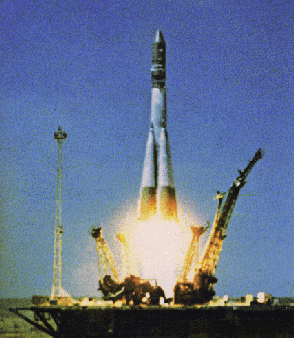
Soviet cosmonaut Yuri Gagarin becomes the first human to travel to space aboard Vostok 1.

Engineers are so unsure whether weightlessness will impair his mind that the manual controls are locked — he is given a sealed envelope with the override code.

Vostok 1 was the first spaceflight of the Vostok programme and the first human orbital spaceflight in history. The Vostok 3KA space capsule was launched from Baikonur Cosmodrome on 12 April 1961, with Soviet cosmonaut Yuri Gagarin aboard, making him the first human to reach orbital velocity around the Earth and to complete a full orbit around the Earth.

📷 Wikimedia Commons

Play today's puzzle ▸