History puzzle · June 11, 2026

Revolutions & independence

When people remade their nations

Difficulty ★★★☆☆ · 10 events

In Hand of History for June 11, 2026 you place these 10 real events back into the order they happened. Here they are in chronological order, with the date revealed and why each one matters.

American independence declared — 1776
1776

The Continental Congress adopts the Declaration of Independence in Philadelphia.

John Hancock signs his name so large he quips the King can read it without his spectacles.

The Declaration of Independence, formally The unanimous Declaration of the thirteen united States of America in the original printing, is the founding document of the United States. On July 4, 1776, it was adopted unanimously by the Second Continental Congress, who were convened at Pennsylvania State House, later renamed Independence Hall, in the colonial city of Philadelphia. These delegates became known as the nation's Founding Fathers. The Declaration explains why the Thirteen Colonies regarded themselves as independent sovereign states no longer subject to British colonial rule, and has become one of the most circulated, reprinted, and influential documents in history.

📷 Wikimedia Commons
Storming of the Bastille — 1789
1789

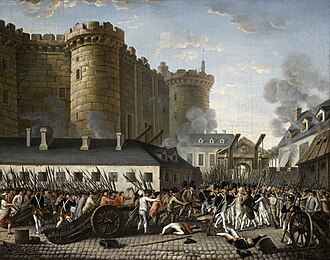
An angry Paris mob storms the Bastille prison, expecting to free hundreds of political prisoners.

They find only seven inmates inside — including two committed for 'lunacy' and four forgers.

The Storming of the Bastille, which occurred in Paris, France, on 14 July 1789, was an act of political violence by revolutionary insurgents who attempted to storm and seize control of the medieval armoury, fortress, and political prison known as the Bastille. After four hours of fighting and 94 deaths, the insurgents were able to enter the Bastille. The governor of the Bastille, Bernard-René Jourdan de Launay, and several members of the garrison were killed after surrendering. At the time, the Bastille represented royal authority in the centre of Paris. The prison contained only seven inmates at the time of its storming and was already scheduled for demolition but was seen by the revolutionaries as a symbol of the monarchy's abuse of power. Its fall was the flashpoint of the French Revolution.

📷 Wikimedia Commons

Haiti declares independence — 1804
1804

Haiti declares independence after the only successful large-scale slave revolt in history.

To name the new nation, leaders reject the colonial 'Saint-Domingue' and revive the indigenous Taíno word 'Ayiti.'

The Haitian Declaration of Independence was proclaimed on 1 January 1804 in the port city of Gonaïves by Jean-Jacques Dessalines, marking the end of 13-year long Haitian Revolution. The declaration marked Haiti becoming the first independent nation of Latin America and the Caribbean, only the second in the Americas after the United States.

📷 Wikimedia Commons

Mexico rings the bell of independence — 1810
1810

Priest Miguel Hidalgo rings his church bell in Dolores and calls the town to revolt against Spanish rule.

His improvised speech, the 'Grito de Dolores,' was never written down, so no one knows exactly what he said.

The Cry of Dolores occurred in Dolores, Mexico, on 16 September 1810, when Roman Catholic priest Miguel Hidalgo y Costilla rang his church bell and gave the call to arms that triggered the Mexican War of Independence. The Cry of Dolores is most commonly known by the locals as El Grito de Independencia.

📷 Wikimedia Commons

Greece declares independence — 1821
1821

Greek revolutionaries raise the banner of revolt against the Ottoman Empire at the Monastery of Agia Lavra.

The romantic cause draws Lord Byron to fight — he dies of fever in Greece before firing a single shot in battle.

The Greek War of Independence, also known as the Greek Revolution or the Greek Revolution of 1821, was a successful war of independence fought by Greek revolutionaries against the Ottoman Empire from 1821 to 1829. In 1826, the Greeks were assisted by the British Empire, the Kingdom of France, and the Russian Empire, while the Ottomans were aided by their vassals, especially by the Eyalet of Egypt. The war led to the formation of modern Greece, which in subsequent years would be expanded to its current size. The revolution is commemorated by the Greek diaspora as independence day on 25 March.

📷 Wikimedia Commons

The Springtime of Nations erupts — 1848
1848

Revolutions erupt in over fifty countries across Europe in a single turbulent year.

Remarkably, Britain — despite severe poverty and Chartist agitation — stays entirely revolution-free.

The revolutions of 1848, also known as the springtime of the peoples, were a series of revolutions throughout Europe that spanned almost two years, between January 1848 and October 1849. They remain the most widespread revolutionary wave in European history to date.

📷 Wikimedia Commons

Paris Commune takes power — 1871
1871

Radical workers seize control of Paris and establish the short-lived Paris Commune.

Before it falls, Communards tear down the Vendôme Column — Napoleon's bronze trophy made from 1,200 captured cannons.

The Paris Commune was a French revolutionary government that seized power in Paris on 18 March 1871 and controlled parts of the city until 28 May 1871. During the Franco-Prussian War of 1870–71, the French National Guard had defended Paris, and working class radicalism grew among its soldiers. Following the establishment of the French Third Republic in September 1870 and the complete defeat of the French Army by the Germans by March 1871, soldiers of the National Guard seized control of the city on 18 March. The Communards killed two French Army generals and refused to accept the authority of the Third Republic; instead, the radicals set about establishing their own independent government.

📷 Wikimedia Commons

Bolsheviks seize Russia — 1917
1917

Lenin's Bolsheviks storm the Winter Palace in Petrograd and seize control of the Russian government.

The 'storming' is mostly a stroll — the palace is guarded by a few cadets and a women's battalion, and they surrender quickly.

The October Revolution, also known as the Great October Socialist Revolution, October coup, Bolshevik coup, Bolshevik Revolution, and occasionally the November Revolution, was the second of two revolutions in Russia in 1917. It was led by Vladimir Lenin's Bolsheviks as part of the broader Russian Revolution of 1917–1923. It began through an insurrection in Petrograd on 7 November 1917 [O.S. 25 October]. It was the precipitating event of the Russian Civil War. The initial stage of the October Revolution, which involved the assault on Petrograd, occurred largely without any casualties.

📷 Wikimedia Commons

India gains independence — 1947
1947

India gains independence from Britain at the stroke of midnight, with Nehru's famous 'tryst with destiny' speech.

Midnight was chosen because it was auspicious — but many astrologers actually considered that particular date unlucky.

The Indian Independence Act 1947 is an act of the Parliament of the United Kingdom that partitioned British India into the two new independent dominions of India and Pakistan. On 15 July 1947 the House of Commons voted for the bill and the House of Lords gave its consent on the next day. The act received Royal Assent on 18 July 1947 and thus modern-day India and Pakistan, comprising west and east regions, came into being on 15 August.

📷 Wikimedia Commons

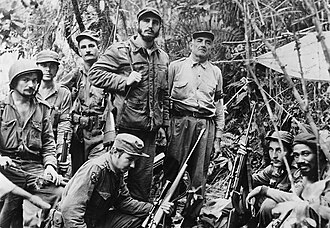
Castro's revolution triumphs in Cuba — 1959
1959

Fidel Castro's rebel army marches into Havana and topples dictator Fulgencio Batista.

Batista flees on New Year's Eve with an estimated $300 million, leaving behind his unfinished champagne.

The Cuban Revolution was the military and political movement that overthrew the dictatorship of Fulgencio Batista, who had ruled Cuba from 1952 to 1959. The revolution began after the 1952 Cuban coup d'état, in which Batista overthrew the emerging Cuban democracy and consolidated power. Among those who opposed the coup was Fidel Castro, then a young lawyer, who initially tried to challenge the takeover through legal means in the Cuban courts. When these efforts failed, Fidel Castro and his brother Raúl led an armed assault on the Moncada Barracks, a Cuban military post, on 26 July 1953.

📷 Wikimedia Commons

Play today's puzzle ▸