History puzzle · June 9, 2026

Voyages & exploration

Charting the unknown

Difficulty ★★☆☆☆ · 10 events

In Hand of History for June 9, 2026 you place these 10 real events back into the order they happened. Here they are in chronological order, with the date revealed and why each one matters.

Leif Erikson reaches North America — 1000
1000

Norse explorer Leif Erikson lands at a lush place he calls Vinland, somewhere on the North American coast.

The settlement is abandoned not because of the ocean crossing, but because the locals — the Skrælings — keep attacking.

Vinland, Vineland, or Winland was an area of coastal North America explored by Vikings. Leif Erikson landed there around AD 1000, nearly five centuries before the voyages of Christopher Columbus and John Cabot. The name appears in the Vinland sagas and describes a land beyond Greenland, Helluland, and Markland. Much of the geographical content of the sagas corresponds to present-day knowledge of transatlantic travel and North America.

📷 Wikimedia Commons

Zheng He's first great voyage — 1405
1405

Chinese admiral Zheng He sets out with a fleet of 317 ships — some nearly five times the size of Columbus's Santa María.

He carries a giraffe back to Beijing as a gift for the emperor, who takes it as proof that heaven favors his reign.

Zheng He was a Chinese explorer, admiral, diplomat, and eunuch from the early Ming dynasty, who is often regarded as the greatest admiral in Chinese history. Born into a Muslim family as Ma He, he later adopted the surname Zheng conferred onto him by the Yongle Emperor.

📷 Wikimedia Commons

Columbus reaches the Americas — 1492
1492

Christopher Columbus makes landfall in the Bahamas, convinced he has reached the outer islands of Asia.

He calls the islanders "Indians" — a mistaken label that sticks to an entire continent for five centuries.

Between 1492 and 1504, the Italian explorer and navigator Christopher Columbus led four Spanish transatlantic maritime expeditions in the name of the Catholic Monarchs to the Americas. These voyages led to Europeans learning about the New World. This was an early breakthrough in the period known in Europe as the Age of Exploration, which saw the colonization of the Americas, a related biological exchange, and trans-Atlantic trade. These events, the effects and consequences of which persist to the present, are often cited as the beginning of the modern era.

📷 Wikimedia Commons

First circumnavigation of the globe — 1522
1522

Juan Sebastián Elcano sails into Seville with just one battered ship and 18 survivors from Magellan's original fleet of 270.

The crew's meticulous logbook records a date one full day behind the calendar in Seville — the first recorded discovery of time zones.

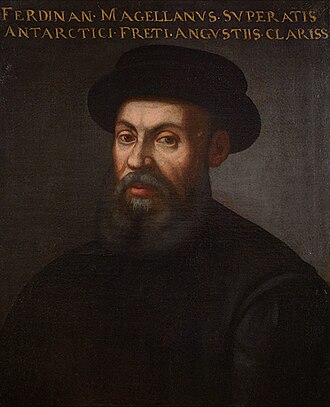
Ferdinand Magellan was a Portuguese explorer best known for planning and leading the 1519–1522 Spanish expedition to the East Indies. During this expedition, he became the first European to encounter the Strait of Magellan, performed the first European crossing of the Pacific Ocean, and made the first known European contact with the Philippines. Magellan himself was killed in battle in the Philippines in 1521, but his crew, commanded by Spanish navigator Juan Sebastián Elcano, completed the return trip to Spain in 1522, achieving the first circumnavigation of Earth in history.

📷 Wikimedia Commons

Francis Drake circumnavigates the globe — 1580
1580

Sir Francis Drake sails into Plymouth harbour aboard the Golden Hind, completing his voyage around the world.

Queen Elizabeth I knights him on deck — directly on the ship — using a sword borrowed from the French ambassador.

The English explorer Francis Drake circumnavigated the Earth between 13 December 1577 and 26 September 1580. The expedition was authorised by Queen Elizabeth I and consisted of five ships. Termed a 'voyage of discovery', it was in effect an ambitious covert raiding voyage and the start of England's challenge to the global domination of Spain and Portugal.

📷 Wikimedia Commons

Henry Hudson discovers Hudson Bay — 1610
1610

Explorer Henry Hudson pushes his ship into the enormous Canadian bay that will carry his name.

His crew mutinies the following winter and sets Hudson, his son, and seven sick sailors adrift in a small open boat, never to be seen again.

Henry Hudson was an English sea explorer and navigator during the early 17th century, best known for his explorations of present-day Canada and parts of the Northeastern United States.

📷 Wikimedia Commons

Bering reaches Alaska — 1741
1741

Danish explorer Vitus Bering sights the Alaskan mainland while sailing under the Russian flag.

Bering never makes it home — he dies shipwrecked on a remote island now called Bering Island, his crew surviving the winter by eating sea otters.

Vitus Jonassen Bering, also known as Ivan Ivanovich Bering, was a Danish-born Russian cartographer, explorer, and officer in the Russian Navy. He is known as a leader of two Russian expeditions, the First Kamchatka Expedition and the Great Northern Expedition, exploring the northeastern coast of the Asian continent and from there the western coast of the North American continent. The Bering Strait, the Bering Sea, Bering Island, the Bering Glacier, and Vitus Lake were all named in his honor.

📷 Wikimedia Commons

Captain Cook's first Pacific voyage — 1768
1768

Captain James Cook departs England aboard HMS Endeavour, officially to observe the transit of Venus from Tahiti.

His secret sealed orders only reveal themselves after the astronomy is done: find and claim the giant undiscovered southern continent.

The first voyage of James Cook was a combined Royal Navy and Royal Society expedition to the south Pacific Ocean aboard HMS Endeavour, from 1768 to 1771. The aims were to observe the 1769 transit of Venus from Tahiti and to seek evidence of the postulated Terra Australis Incognita or "undiscovered southern land". It was the first of three voyages of which Cook was the commander.

📷 Wikimedia Commons

Lewis and Clark expedition begins — 1804
1804

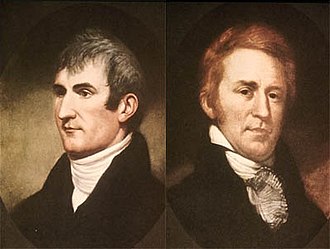
Meriwether Lewis and William Clark set off up the Missouri River with a 33-person Corps of Discovery.

Their most indispensable guide, Sacagawea, is just 16 years old and pregnant when the journey begins.

The Lewis and Clark Expedition, also known as the Corps of Discovery Expedition, was the United States expedition to cross the newly acquired western portion of the country after the Louisiana Purchase. The Corps of Discovery was a select group of U.S. Army and civilian volunteers under the command of Captain Meriwether Lewis and his close friend Second Lieutenant William Clark. Clark, along with 30 others, set out from Camp Dubois, Illinois, on May 14, 1804, met Lewis and ten other members of the group in St. Charles, Missouri, then went up the Missouri River. The expedition crossed the Continental Divide of the Americas near the Lemhi Pass, eventually coming to the Columbia River, and the Pacific Ocean in 1805. The return voyage began on March 23, 1806, at Fort Clatsop, Oregon, ending six months later on September 23.

📷 Wikimedia Commons

Amundsen reaches the South Pole — 1911
1911

Norwegian explorer Roald Amundsen plants his country's flag at the South Pole, beating Scott's British team by 34 days.

He leaves Scott a polite tent note and a spare sextant inside — a gesture Scott will read in despair before dying on the return march.

The first expedition to reach the Geographic South Pole was led by the Norwegian explorer Roald Amundsen. He and four other crew members made it to the geographical South Pole on 14 December 1911, which was to be five weeks ahead of the British party led by Robert Falcon Scott as part of the Terra Nova Expedition. Amundsen and his team returned safely to their base, and about a year later heard that Scott and his four companions had perished on their return journey.

📷 Wikimedia Commons

Play today's puzzle ▸