History puzzle · June 8, 2026

Ancient wonders & empires

The deep past

Difficulty ☆☆☆☆ · 10 events

In Hand of History for June 8, 2026 you place these 10 real events back into the order they happened. Here they are in chronological order, with the date revealed and why each one matters.

Great Pyramid rises at Giza — 2560 BC
2560 BC

Workers complete the Great Pyramid of Giza for Pharaoh Khufu.

It is built from roughly 2.3 million stone blocks — and not one ramp, rope, or tool has ever been found inside.

The Great Pyramid of Giza is the largest of the Egyptian pyramids and the most famous landmark of the Giza pyramid complex in Giza, Egypt. It is the oldest of the Seven Wonders of the Ancient World, and the only wonder that has remained largely intact. The Great Pyramid served as the tomb of Egyptian Pharaoh Khufu ("Cheops"), who ruled during the Fourth Dynasty of the Old Kingdom. It was built c. 2600 BC over a period of about 26 years.

📷 Wikimedia Commons

Parthenon completed in Athens — 432 BC
432 BC

Athenian builders finish the Parthenon on the Acropolis, dedicated to the goddess Athena.

Its columns subtly bow outward so that, to the human eye, they appear perfectly straight — an optical trick baked into the stone.

The Parthenon is a former temple on the Athenian Acropolis, Greece, that was dedicated to the goddess Athena. Its decorative sculptures are considered some of the high points of classical Greek art, and the Parthenon is considered an enduring symbol of ancient Greece, Western civilisation, and democracy.

📷 Wikimedia Commons

Alexander defeats the Persian Empire — 330 BC
330 BC

Alexander the Great sacks Persepolis, the grand capital of the Persian Empire.

He reportedly sets the palace ablaze at the suggestion of an Athenian courtesan named Thais, just to entertain the party.

Alexander III of Macedon, most commonly known as Alexander the Great, was king of the ancient Greek kingdom of Macedon. He succeeded his father Philip II to the throne in 336 BC at the age of 20, and spent most of his reign conducting a lengthy military campaign throughout Asia and Egypt. By the age of 30, he had created one of the largest empires in history, stretching from Greece to northwestern India. He was undefeated in battle and is widely considered to be one of history's greatest and most successful military commanders.

📷 Wikimedia Commons

Colossus of Rhodes erected — 280 BC
280 BC

The people of Rhodes unveil a colossal bronze statue of the sun-god Helios at their harbor.

It stands for only 54 years before an earthquake snaps it at the knees — and it lies in pieces for another 800 years.

The Colossus of Rhodes was a statue of the Greek sun god Helios, erected in the city of Rhodes, on the Greek island of the same name, by Chares of Lindos in 280 BC. One of the Seven Wonders of the Ancient World, it was constructed to celebrate the successful defence of Rhodes against an attack by Demetrius I of Macedon, who had besieged it for a year with a large army and navy.

📷 Wikimedia Commons

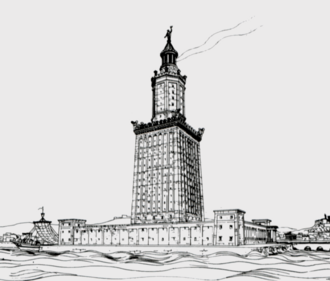
Lighthouse of Alexandria built — 280 BC
280 BC

Workers on the island of Pharos complete a towering lighthouse to guide ships into Alexandria's busy harbor.

At roughly 100 meters tall, it is one of the tallest man-made structures on Earth for nearly 1,500 years — until a series of earthquakes finally drops it into the sea.

The Lighthouse of Alexandria, sometimes called the Pharos of Alexandria, was a lighthouse built by the Ptolemaic Kingdom of Ancient Egypt, during the reign of Ptolemy II Philadelphus. It has been estimated to have been at least 100 metres (330 ft) in overall height. One of the Seven Wonders of the Ancient World, for many centuries it was one of the world's tallest man-made structures.

📷 Wikimedia Commons

Terracotta Army buried with Qin Shi Huang — 210 BC
210 BC

China's first emperor, Qin Shi Huang, is entombed with an army of more than 8,000 life-sized terracotta soldiers.

Every single warrior face is said to be unique — and the tomb itself has never been opened, reportedly filled with rivers of liquid mercury.

The Terracotta Army is a collection of terracotta sculptures depicting the armies of Qin Shi Huang, the first emperor of China. It is a form of funerary art buried with the emperor in 210–209 BCE in his mausoleum with the purpose of protecting him in his afterlife.

📷 Wikimedia Commons

Julius Caesar assassinated — 44 BC
44 BC

A group of Roman senators stab Julius Caesar to death on the floor of the Theatre of Pompey.

He is stabbed 23 times, but a Roman physician later determines that only one wound was actually fatal.

Julius Caesar, the Roman dictator, was assassinated on the Ides of March, 44 BC, by a group of senators during a Senate session at the Curia of Pompey, located within the Theatre of Pompey in Rome. The conspirators, numbering 60 individuals and led by Marcus Junius Brutus, Gaius Cassius Longinus, and Decimus Junius Brutus Albinus, stabbed Caesar approximately 23 times. They justified the act as a preemptive defense of the Roman Republic, asserting that Caesar's accumulation of lifelong political authority—including his perpetual dictatorship and other honors—threatened republican traditions. The assassination failed to achieve its immediate objective of restoring the Republic's institutions. Instead, it precipitated Caesar's posthumous deification, triggered the Liberators' civil war between his supporters and the conspirators, and contributed to the collapse of the Republic. These events ultimately culminated in the rise of the Roman Empire under Augustus, marking the beginning of the Principate era.

📷 Wikimedia Commons

Colosseum opens in Rome — 80
80

Emperor Titus inaugurates the newly completed Colosseum in Rome with 100 days of games.

The opening spectacle reportedly kills 9,000 animals — and a retractable awning shades the crowd from the sun.

The Colosseum is an elliptical amphitheatre in the centre of the city of Rome, Italy, just east of the Roman Forum. It is the largest ancient amphitheatre ever built, and is the largest standing amphitheatre in the world. Construction began under the Emperor Vespasian in 72 and was completed in AD 80 under his successor and heir, Titus. Further modifications were made during the reign of Domitian. The three emperors who were patrons of the work are known as the Flavian dynasty, and the amphitheatre was named the Flavian Amphitheatre by later classicists and archaeologists for its association with their family name (Flavius).

📷 Wikimedia Commons

Western Roman Empire falls — 476
476

Germanic chieftain Odoacer deposes Romulus Augustulus, the last emperor of the Western Roman Empire.

The empire ends not with a dramatic last stand but with a teenager sent to retire in a castle by the sea in southern Italy.

The fall of the Western Roman Empire, also called the fall of the Roman Empire or the fall of Rome, was the loss of central political control in the Western Roman Empire, a process in which the Empire failed to enforce its rule, and its vast territory was divided among several successor polities. The Roman Empire lost the strengths that had allowed it to exercise effective control over its Western provinces; modern historians posit factors including the effectiveness and numbers of the army, the health and numbers of the Roman population, the strength of the economy, the competence of the emperors, the internal struggles for power, the religious changes of the period, and the efficiency of the civil administration. Increasing pressure from invading peoples outside Roman culture also contributed greatly to the collapse. Climatic changes and both endemic and epidemic diseases drove many of these immediate factors. The reasons for the collapse are major subjects of the historiography of the ancient world and they inform much modern discourse on state failure.

📷 Wikimedia Commons

Hagia Sophia completed in Constantinople — 537
537

Emperor Justinian I consecrates the newly finished Hagia Sophia in Constantinople.

When Justinian first walks inside and sees the enormous dome, he reportedly shouts, "Solomon, I have surpassed thee!"

Hagia Sophia, officially the Hagia Sophia Grand Mosque, is a mosque and a major cultural and historical site in Istanbul, Turkey. It was formerly a church (360–1453) and a museum (1935–2020). The last of three church buildings to be successively erected on the site by the Eastern Roman Empire, it was completed in AD 537, becoming the world's largest interior space and among the first to employ a fully pendentive dome. It is considered the epitome of Byzantine architecture and is said to have "changed the history of architecture". From its dedication in 360 until 1453, Hagia Sophia served as the cathedral of Constantinople in the Byzantine liturgical tradition, except for the period 1204–1261 when the Latin Crusaders installed their own hierarchy. After the fall of Constantinople in 1453, it served as a mosque, having its minarets added soon after. The site became a museum in 1935, and was redesignated as a mosque in 2020.

📷 Wikimedia Commons

Play today's puzzle ▸