History puzzle · June 6, 2026

20th-century firsts

The tightly-packed century

Difficulty ★★★★★ · 10 events

In Hand of History for June 6, 2026 you place these 10 real events back into the order they happened. Here they are in chronological order, with the date revealed and why each one matters.

Baird demonstrates television — 1926
1926

John Logie Baird demonstrates a working television system to fifty scientists at his London attic laboratory.

His first 'studio' camera subject is a ventriloquist's dummy named 'Stooky Bill,' because the studio lights are too hot for a real person's face.

John Logie Baird was a Scottish inventor, electrical engineer and innovator who demonstrated the world's first mechanical television system on 26 January 1926. He went on to invent the first publicly demonstrated colour television system and the first viable purely electronic colour television picture tube.

📷 Wikimedia Commons

1927

Charles Lindbergh lands in Paris after flying solo and nonstop across the Atlantic in his plane, Spirit of St. Louis.

He stays awake for 33.5 hours by slapping himself, dangling his feet out the cockpit, and flying just ten feet above the ocean waves.

Charles Lindbergh's solo nonstop transatlantic flight proved that air travel could one day connect continents.

First 'talkie' film released — 1927
1927

Warner Bros. releases The Jazz Singer, the first feature-length film with synchronized dialogue.

Al Jolson's ad-libbed line — 'You ain't heard nothin' yet!' — becomes the first words spoken in a mainstream Hollywood film.

The Jazz Singer is a 1927 American part-talkie musical drama film directed by Alan Crosland and produced by Warner Bros. Pictures. It is the first feature-length motion picture with both synchronized recorded music and lip-synchronous singing and speech. Its release heralded the commercial ascendance of sound films and effectively marked the end of the silent film era with the Vitaphone sound-on-disc system, featuring six songs performed by Al Jolson. Based on the 1925 play of the same title by Samson Raphaelson, the plot was adapted from his short story "The Day of Atonement".

📷 Wikimedia Commons

Fleming discovers penicillin — 1928
1928

Alexander Fleming notices that mold has killed the bacteria in one of his petri dishes at St. Mary's Hospital, London.

He almost throws the contaminated dish away — the world-changing discovery is rescued from the rubbish bin.

The discovery of penicillin was one of the most important scientific discoveries in the history of medicine. Ancient societies used moulds to treat infections and in the following centuries many people observed the inhibition of bacterial growth by moulds. While working at St Mary's Hospital in London in 1928, Scottish physician Alexander Fleming was the first to experimentally demonstrate that a Penicillium mould secretes an antibacterial substance, which he named "penicillin". The mould was found to be a variant of Penicillium notatum, a contaminant of a bacterial culture in his laboratory. The work on penicillin at St Mary's ended in 1929.

📷 Wikimedia Commons

Yeager breaks the sound barrier — 1947
1947

U.S. Air Force pilot Chuck Yeager flies the Bell X-1 faster than the speed of sound over the Mojave Desert.

He names the plane 'Glamorous Glennis' after his wife — and boards with two secretly broken ribs from a horse-riding accident two nights before.

The Bell X-1 is a rocket engine–powered aircraft, designated originally as the XS-1, and was a joint National Advisory Committee for Aeronautics–U.S. Army Air Forces–U.S. Air Force supersonic research project built by Bell Aircraft. Conceived during 1944 and designed and built in 1945, it achieved a speed of nearly 1,000 miles per hour in 1948. A derivative of this same design, the Bell X-1A, having greater fuel capacity and hence longer rocket burning time, exceeded 1,600 miles per hour in 1954. The X-1 aircraft #46-062, nicknamed Glamorous Glennis and flown by Chuck Yeager, was the first piloted airplane to exceed the speed of sound in level flight and was the first of the X-planes, a series of American experimental rocket planes designed for testing new technologies.

📷 Wikimedia Commons

1950

Frank McNamara launches the Diners Club card, the world's first general-purpose credit card, in New York City.

The idea came to him after he left his wallet at home during a business dinner — a moment he called his 'first supper.'

Diners Club International Ltd. (DCI), founded as Diners Club, is a charge card company owned by Capital One. Formed in 1950 by Frank X. McNamara, Ralph Schneider (1909–1964), Matty Simmons, and Alfred S. Bloomingdale, it was the first independent payment card company in the world, successfully establishing the financial card service of issuing travel and entertainment (T&E) credit cards as a viable business. Diners Club International and its franchises serve members globally, with acceptance in over 200 countries and territories. As of 2024–2025, the network includes more than 55 card issuers operating in approximately 45 countries.

1954

Dr. Joseph Murray performs the first successful human kidney transplant between identical twins at Peter Bent Brigham Hospital in Boston.

The donor twin, Ronald Herrick, lives another 56 years — outlasting the surgical team, the hospital's original name, and the transplant recipient himself.

The first successful human organ transplant proved the body could accept a donated organ, founding the field of transplant medicine.

Sputnik orbits Earth — 1957
1957

The Soviet Union launches Sputnik 1, the first artificial satellite to orbit Earth, into space.

Any amateur radio enthusiast on Earth can tune in and hear it beeping — the signal is intentionally simple so no one can claim they didn't pick it up.

Sputnik 1, often referred to as simply Sputnik, was the first artificial Earth satellite. It was launched into an elliptical low Earth orbit by the Soviet Union on 4 October 1957 as part of the Soviet space program. It sent a radio signal back to Earth for three weeks before its three silver-zinc batteries became depleted. Aerodynamic drag caused it to fall back into the atmosphere on 4 January 1958.

📷 Wikimedia Commons

Gagarin flies in space — 1961
1961

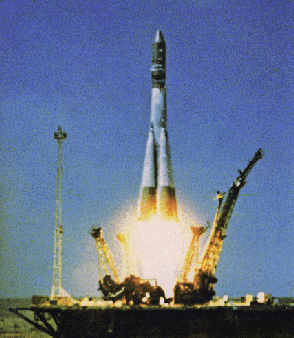
Soviet cosmonaut Yuri Gagarin completes a single orbit of Earth aboard Vostok 1, becoming the first human in space.

Engineers are so unsure a human can function in weightlessness that the controls are locked — Gagarin is given a sealed envelope with the override code, just in case.

Vostok 1 was the first spaceflight of the Vostok programme and the first human orbital spaceflight in history. The Vostok 3KA space capsule was launched from Baikonur Cosmodrome on 12 April 1961, with Soviet cosmonaut Yuri Gagarin aboard, making him the first human to reach orbital velocity around the Earth and to complete a full orbit around the Earth.

📷 Wikimedia Commons

1967

Dr. Christiaan Barnard performs the world's first human-to-human heart transplant at Groote Schuur Hospital in Cape Town, South Africa.

The donor's heart comes from a young woman killed in a car accident — her father, standing in the next room, is asked to give consent while the operation is already being prepared.

Christiaan Barnard's heart transplant redefined the boundaries of surgery and forced the world to reckon with the definition of death.

Play today's puzzle ▸