History puzzle · June 1, 2026

Ancient wonders & empires

The deep past

Difficulty ☆☆☆☆ · 10 events

In Hand of History for June 1, 2026 you place these 10 real events back into the order they happened. Here they are in chronological order, with the date revealed and why each one matters.

Great Pyramid of Giza Completed — 2560 BC
2560 BC

Great Pyramid of Giza Completed

Pharaoh Khufu's tomb becomes the tallest man-made structure on Earth, a record it holds for nearly 4,000 years.

The Great Pyramid of Giza is the largest of the Egyptian pyramids and the most famous landmark of the Giza pyramid complex in Giza, Egypt. It is the oldest of the Seven Wonders of the Ancient World, and the only wonder that has remained largely intact. The Great Pyramid served as the tomb of Egyptian Pharaoh Khufu ("Cheops"), who ruled during the Fourth Dynasty of the Old Kingdom. It was built c. 2600 BC over a period of about 26 years.

📷 Wikimedia Commons

Rome Is Founded — 753 BC
753 BC

Rome Is Founded

Traditional founding of Rome by Romulus marks the beginning of a city-state that will grow into history's most influential empire.

Archaeological evidence indicates that Rome developed from the gradual union of several hilltop villages during the Final Bronze Age or early Iron Age. Prehistoric habitation of the Italian Peninsula occurred by 48,000 years ago, with the area of Rome being settled by around 1600 BC. Some evidence on the Capitoline Hill possibly dates as early as c. 1700 BC and the nearby valley that later housed the Roman Forum had a developed necropolis by at least 1000 BC. The combination of the hilltop settlements into a single polity by the later 8th century BC was probably influenced by the trend for city-state formation emerging from ancient Greece.

📷 Wikimedia Commons

Parthenon Completed in Athens — 432 BC
432 BC

Parthenon Completed in Athens

The magnificent temple to Athena atop the Acropolis stands as the supreme achievement of ancient Greek architecture and democracy.

The Parthenon is a former temple on the Athenian Acropolis, Greece, that was dedicated to the goddess Athena. Its decorative sculptures are considered some of the high points of classical Greek art, and the Parthenon is considered an enduring symbol of ancient Greece, Western civilisation, and democracy.

📷 Wikimedia Commons

Alexander the Great Conquers Persia — 330 BC
330 BC

Alexander the Great Conquers Persia

Alexander's defeat of Darius III and burning of Persepolis ends the Achaemenid Empire and spreads Greek culture across three continents.

The wars of Alexander the Great were a series of conquests and military campaigns carried out by Alexander III of Macedon from 336 to 323 BC. They began with his conquest of the Achaemenid Empire, which was ruled by Darius III. After a series of victories over the Persians and the defeat of Darius, he began a campaign against local chieftains and warlords that stretched from Greece to as far as the Indus Valley. At the time of his death, Alexander ruled over most regions of Greece and the conquered Achaemenid Empire, including much of Achaemenid Egypt.

📷 Wikimedia Commons

Colossus of Rhodes Erected — 280 BC
280 BC

Colossus of Rhodes Erected

This giant bronze statue of the sun god Helios, one of the Seven Wonders, celebrated Rhodes' victory over a Macedonian siege and dominated the ancient Aegean world.

The Colossus of Rhodes was a statue of the Greek sun god Helios, erected in the city of Rhodes, on the Greek island of the same name, by Chares of Lindos in 280 BC. One of the Seven Wonders of the Ancient World, it was constructed to celebrate the successful defence of Rhodes against an attack by Demetrius I of Macedon, who had besieged it for a year with a large army and navy.

📷 Wikimedia Commons

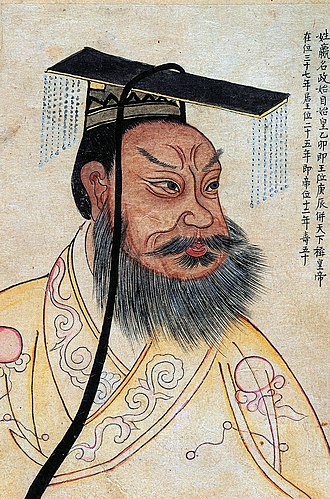
Qin Shi Huang Unifies China — 221 BC
221 BC

Qin Shi Huang Unifies China

The first emperor of a unified China establishes a centralized imperial system that shapes East Asian civilization for over two millennia.

Qin Shi Huang was the founder of the Qin dynasty and the first emperor of China. He invented the title huángdì rather than reuse the existing title for "king" ; the new title was used by monarchs in China and other countries for the next two millennia.

📷 Wikimedia Commons

Julius Caesar Is Assassinated — 44 BC
44 BC

Julius Caesar Is Assassinated

The murder of Rome's most powerful dictator triggers a chain of civil wars that transforms the Roman Republic into the mighty Roman Empire.

Julius Caesar, the Roman dictator, was assassinated on the Ides of March, 44 BC, by a group of senators during a Senate session at the Curia of Pompey, located within the Theatre of Pompey in Rome. The conspirators, numbering 60 individuals and led by Marcus Junius Brutus, Gaius Cassius Longinus, and Decimus Junius Brutus Albinus, stabbed Caesar approximately 23 times. They justified the act as a preemptive defense of the Roman Republic, asserting that Caesar's accumulation of lifelong political authority—including his perpetual dictatorship and other honors—threatened republican traditions. The assassination failed to achieve its immediate objective of restoring the Republic's institutions. Instead, it precipitated Caesar's posthumous deification, triggered the Liberators' civil war between his supporters and the conspirators, and contributed to the collapse of the Republic. These events ultimately culminated in the rise of the Roman Empire under Augustus, marking the beginning of the Principate era.

📷 Wikimedia Commons

Roman Colosseum Inaugurated — 80
80

Roman Colosseum Inaugurated

Emperor Titus opens the massive amphitheatre in Rome, which holds up to 80,000 spectators and becomes an enduring symbol of imperial power.

The Colosseum is an elliptical amphitheatre in the centre of the city of Rome, Italy, just east of the Roman Forum. It is the largest ancient amphitheatre ever built, and is the largest standing amphitheatre in the world. Construction began under the Emperor Vespasian in 72 and was completed in AD 80 under his successor and heir, Titus. Further modifications were made during the reign of Domitian. The three emperors who were patrons of the work are known as the Flavian dynasty, and the amphitheatre was named the Flavian Amphitheatre by later classicists and archaeologists for its association with their family name (Flavius).

📷 Wikimedia Commons

Constantinople Founded as New Rome — 330
330

Constantinople Founded as New Rome

Emperor Constantine dedicates his rebuilt city on the Bosporus, shifting the empire's center of gravity eastward for over a millennium.

Constantinople was the historical name for the city of Istanbul up until 1930, located on a peninsula at the southeastern tip of Thrace in Europe; with the Bosporus strait and the ancient cities of Chalcedon and Chrysopolis in Bithynia, Anatolia to the east; the Golden Horn and the citadel of Galata (Pera) to the north; the Sea of Marmara to the south; and the Princes' Islands to the southeast. Constantinople served as the capital of the Roman, Byzantine, Latin, and Ottoman Empires between its consecration in 330 and the formal abolition of the Ottoman sultanate in 1922.

📷 Wikimedia Commons

Western Roman Empire Falls — 476
476

Western Roman Empire Falls

The deposition of Romulus Augustulus by Odoacer traditionally marks the end of ancient Rome and the dawn of the Middle Ages.

The fall of the Western Roman Empire, also called the fall of the Roman Empire or the fall of Rome, was the loss of central political control in the Western Roman Empire, a process in which the Empire failed to enforce its rule, and its vast territory was divided among several successor polities. The Roman Empire lost the strengths that had allowed it to exercise effective control over its Western provinces; modern historians posit factors including the effectiveness and numbers of the army, the health and numbers of the Roman population, the strength of the economy, the competence of the emperors, the internal struggles for power, the religious changes of the period, and the efficiency of the civil administration. Increasing pressure from invading peoples outside Roman culture also contributed greatly to the collapse. Climatic changes and both endemic and epidemic diseases drove many of these immediate factors. The reasons for the collapse are major subjects of the historiography of the ancient world and they inform much modern discourse on state failure.

📷 Wikimedia Commons

Play today's puzzle ▸